
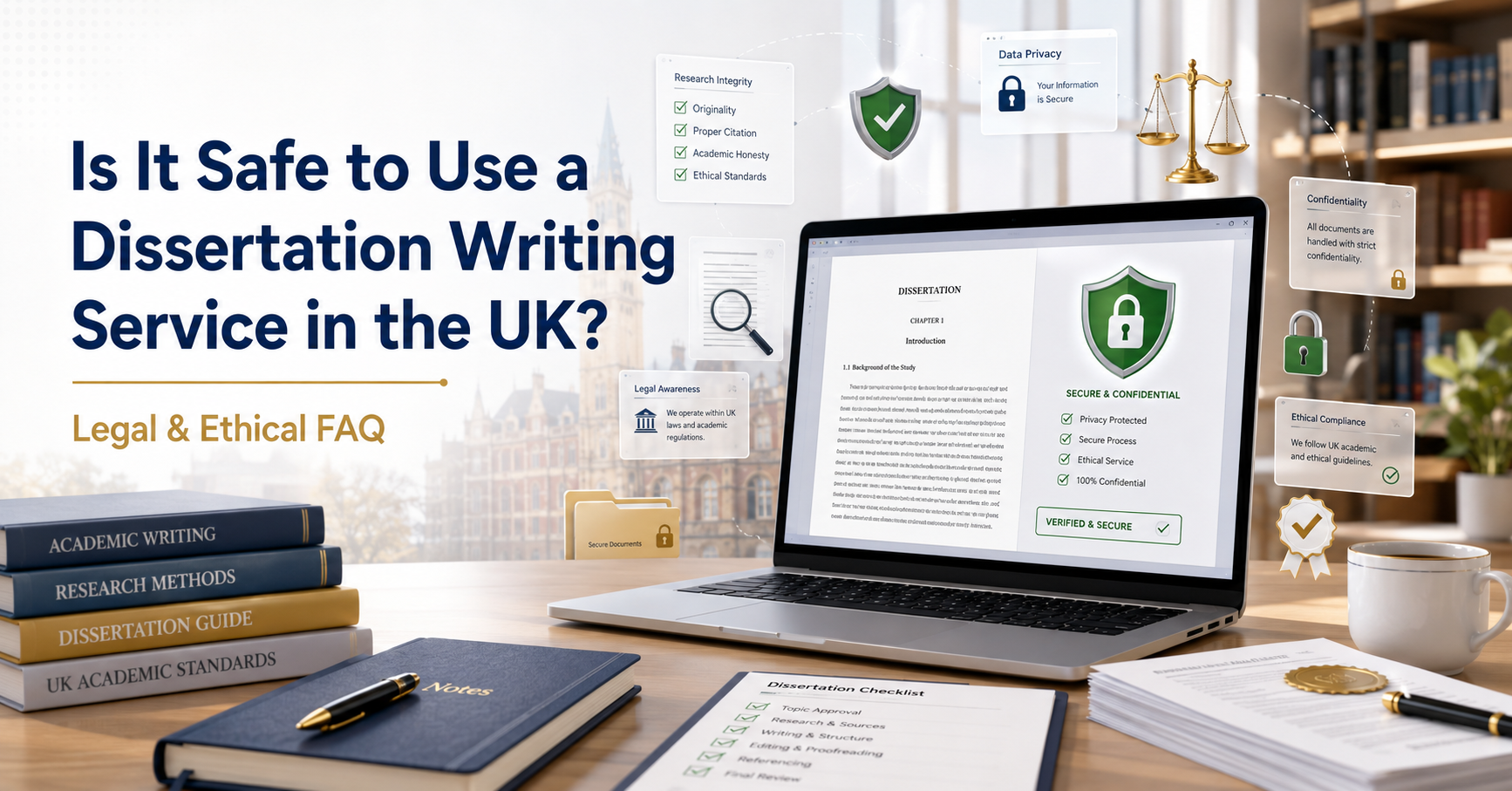
Is It Safe to Use a Dissertation Writing Service in the UK?
Every year, as deadlines close in, thousands of UK students type some version of the same question into Google. Is it legal to use a dissertation writing service. Will my university find out. Am I going to get expelled for this. If you have landed here with the same worry sitting in the back of your mind, you deserve a straight answer rather than a sales pitch, so that is what this article sets out to give you.
Is It Actually Legal?
Yes. Running a business that provides research, writing, editing, or tutoring support is entirely legal in the UK. Companies like ours operate the same way a private tutor, a proofreading service, or a study skills coach does. There is no law against paying someone to help you understand a topic, structure an argument, or polish your writing.
What the law does not cover, and what universities take extremely seriously, is what you personally choose to do with the material you receive. This is where the real question lies, and it has nothing to do with legality and everything to do with your university's own academic conduct rules.
What Universities Actually Prohibit
Every UK university has an academic integrity policy, and while the wording differs slightly between institutions, the core principle is the same everywhere. Submitting work that is not your own, and presenting it as though it is, counts as academic misconduct. This is usually described as contract cheating, and it is treated as a serious offence, with consequences ranging from a capped grade to expulsion in serious or repeated cases.
The Quality Assurance Agency for Higher Education, which sets standards across UK universities, has published clear guidance warning students against submitting purchased work as their own. Some universities have gone further and made it a criminal offence under local by laws to advertise essay writing services to their students, though this targets the advertising rather than the student using support.
None of this means academic support itself is banned. It means the responsibility sits with how the material is used once it is in your hands.
The Line Between Support and Misconduct
This is the part most students genuinely get confused about, often because nobody explains it clearly during induction week. A rough way to think about it is this. Using a service to understand a concept, check your structure, review your draft, or model how a strong piece of writing looks is support. Submitting a document written by someone else, in full or in large part, as your own original work is misconduct.
Reputable services will tell you this openly rather than pretending otherwise. A sample dissertation chapter, a model answer, or a proofread draft is meant to be a learning tool and reference point, not a final submission. Universities generally have no issue with students seeking tutoring, using reference materials, hiring proofreaders for grammar and clarity, or getting feedback on their own drafts. Where things go wrong is when a purchased piece of work is handed in wholesale, with no personal input, as though the student wrote it themselves.
If you are ever unsure where a specific piece of help falls on that line, your own university's academic integrity policy, usually available through the student handbook or the registry office, is the definitive answer, not a company's marketing page.
Will Turnitin or AI Detection Catch It?
Turnitin compares submitted work against a database of academic papers, web content, and previously submitted student work to flag matching text. A well-written custom piece with proper citations will not trigger a plagiarism match in the way copied text would, because the words themselves are original. That said, Turnitin is a similarity checker, not a lie detector, and it was never designed to determine authorship on its own.
AI detection tools are a newer and messier part of this picture. Since 2023, UK universities have increasingly layered AI writing detectors on top of Turnitin, and these tools have well documented reliability problems, including flagging human-written text as AI generated. Several UK universities have publicly acknowledged that AI detection scores alone are not treated as conclusive proof of misconduct, precisely because of these false positive issues. Academic misconduct panels generally look at a combination of evidence, not a single automated score, before reaching a conclusion.
The safest position for any student is not to rely on any tool being fooled, but to be genuinely confident that the work submitted reflects their own understanding and their own writing, which brings us back to how support should actually be used.
How to Use a Writing Service the Right Way
If you decide academic support is something you need, and there is no shame in that given how demanding dissertation projects are, using it responsibly protects both your grade and your integrity.
Treat sample work as a reference, not a submission. A well-structured model dissertation chapter shows you how arguments are built, how sources are integrated, and how academic tone actually sounds in practice. Reading it, taking notes, and then writing your own version in your own words is a completely legitimate way to learn.
Use proofreading and editing services on your own drafts rather than someone else's finished work. Having a professional tidy up your grammar, flag unclear arguments, or check your referencing style is no different from a university writing centre appointment, and most UK universities explicitly permit this kind of support.
Ask for guidance on structure and methodology rather than a finished product when you are stuck. Understanding how to frame a research question or organise a literature review is a skill you will need again, and building it now saves you in your next module or your career beyond university.
Check your specific university's policy before ordering anything. Some institutions have more restrictive interpretations of acceptable support than others, and a five minute read of your handbook can prevent a serious misunderstanding later.
A Fair Answer to a Fair Question
Using a dissertation writing service is not illegal, and reputable providers are upfront that their samples and drafts are learning aids rather than shortcuts to a submitted grade. The real risk sits entirely with how a student chooses to use the material, and that risk is easy to manage with a bit of honesty about your own submission.
If your goal is genuinely to understand your topic better, see what strong academic writing looks like, or get an experienced set of eyes on your own draft, that is exactly the kind of support these services were built for, and it carries none of the risk that worried students are usually Googling about at 2am before a deadline.

Comments (0)
Leave a Comment