
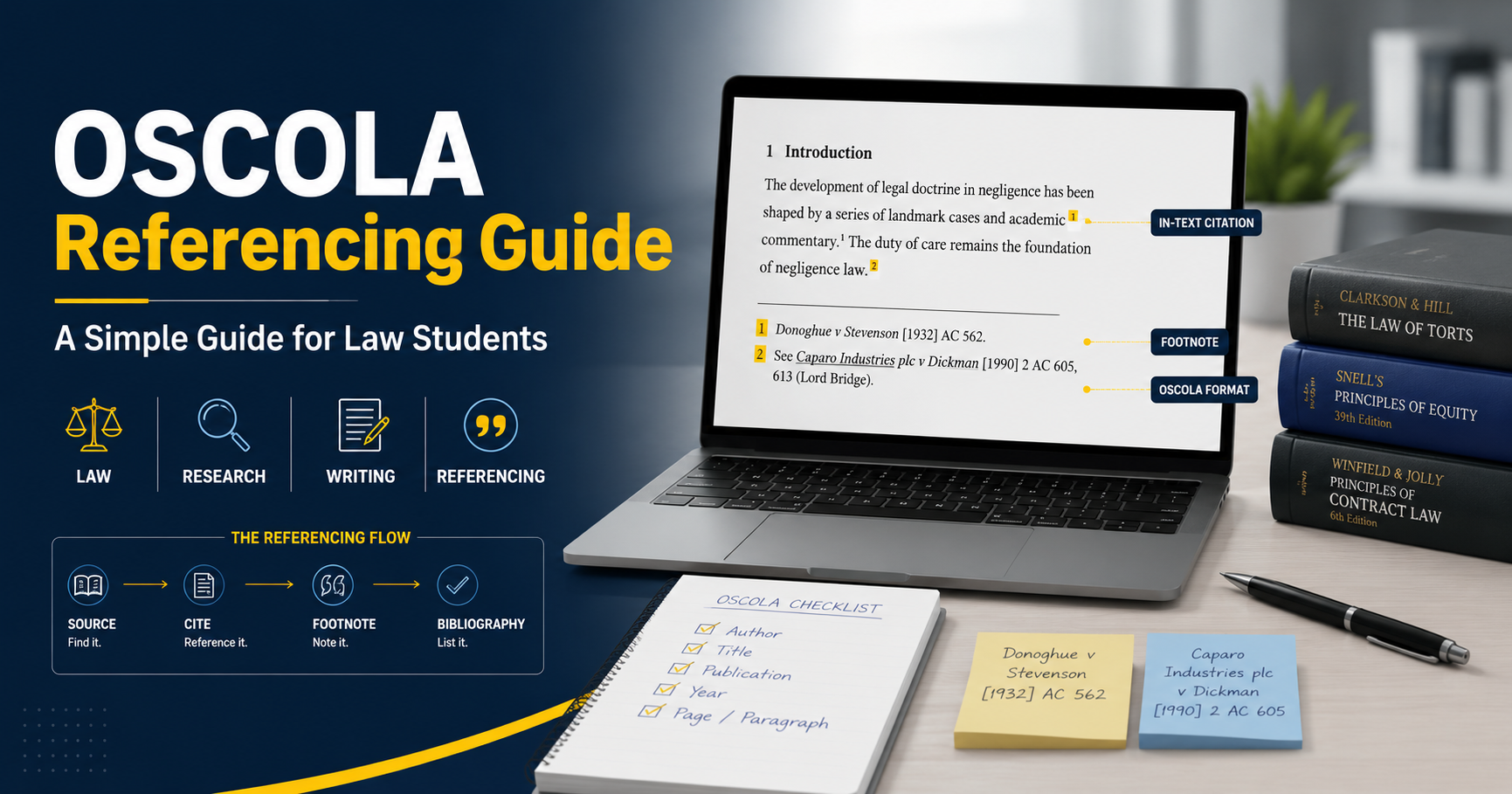
OSCOLA Referencing Guide for Law Students
When you sit down to write a dissertation, essay or dissertation chapter, the first question that often looms large is how to reference sources correctly. For law students in the United Kingdom, the Oxford Standard for the Citation of Legal Authorities (OSCOLA) is the definitive style, and mastering it can make the difference between a polished piece of scholarship and one that looks careless. This guide walks you through the essentials of OSCOLA, offering clear examples, practical tips and common pitfalls to avoid, so you can focus on the substance of your argument rather than the mechanics of citation.
Why OSCOLA Matters for Law Students
Legal writing relies heavily on precedent, statutes and academic commentary. Unlike other citation styles that blend footnotes and reference lists, OSCOLA uses footnotes exclusively and follows a strict order of information. This consistency helps readers trace authorities quickly, demonstrates your attention to detail and, crucially, aligns your work with the expectations of UK law faculties, journals and courts. A well‑crafted footnote signals that you respect the scholarly conversation you are entering.
Fundamental Principles of OSCOLA
Footnotes, Not In‑Text Citations
Every reference appears in a footnote at the bottom of the page on which the source is first mentioned. The main text contains only a superscript number that corresponds to the footnote. This approach keeps the narrative flow uninterrupted, a feature that many law students find particularly helpful when constructing complex arguments.
Full Details at First Mention
The first time you cite a source, you must provide the complete bibliographic information. Subsequent citations of the same work can be shortened, using a shortened form that includes the author's surname, a shortened title and the pinpoint page number.
No Reference List Required
Because OSCOLA relies on footnotes, a separate bibliography is optional unless your department explicitly asks for one. If you do include a bibliography, it should be alphabetised by author and placed after the footnotes.
Pinpoint Citations
Law students are expected to direct readers to the exact page or paragraph where the relevant proposition appears. This means that after the main citation you add a comma followed by the page number, paragraph number or section heading.
How to Cite Different Types of Sources
Books
For a monograph, the basic format is:
Author, Title (edition, Publisher year) page.
Example:
1. Jane Smith, Principles of Contract Law (2nd edn, Oxford University Press 2020) 45.
If you refer to the same book again, you can shorten the citation:
2. Smith, Principles 78.
Edited Volumes
When citing a chapter in an edited collection, include the chapter author, chapter title, the word “in” followed by the editor’s name, the volume title, and the page range of the chapter.
Example:
3. Michael Brown, ‘Consideration in Modern Contracts’ in Sarah Green (ed), Contractual Theory (Cambridge University Press 2019) 112‑130, 118.
Journal Articles
The format for a journal article is:
Author, ‘Article Title’ (year) volume Journal abbreviation page.
Example:
4. Laura Jones, ‘The Role of Intent in Criminal Law’ (2021) 78 Crim L Rev 233, 240.
Online Sources
For websites, include the author (if known), the title of the page, the website name, the date of publication or last update (if available), the URL and the date you accessed the material.
Example:
5. Ministry of Justice, ‘Guidance on the Use of Electronic Evidence’ (2022) https://www.gov.uk/government/publications/electronic-evidence-guidance accessed 12 March 2024.
Legislation
Statutes are cited by their short title, year and, where relevant, the chapter number. Use brackets for the year if the act is a public general act, and no brackets for private or local acts.
Example:
6. Human Rights Act 1998, s 2(1).
For EU legislation, include the Official Journal reference:
7. Regulation (EU) 2016/679 (General Data Protection Regulation) OJ L119/1.
Case Law
Cases are cited by the case name in italics, the neutral citation (if available), the law report series, the volume number, the first page and, where required, a pinpoint citation.
Example:
8. R v Brown [1994] 1 AC 212, 218.
If a case does not have a neutral citation, use the law report reference alone:
9. Donoghue v Stevenson (1932) AC 562, 564.
Practical Tips for Consistency
Consistency is the hallmark of a professional legal document. Here are a few habits that can save you time and reduce errors.
First, keep a dedicated spreadsheet or reference manager file where you record every source as you encounter it. Include fields for author, title, year, publisher, and pinpoint pages. When you later insert footnotes, you can copy the full citation directly, then edit the pinpoint reference as needed.
Second, adopt a standard order for footnotes. Begin with the author’s surname, then the title, then publication details. Even when you are tempted to vary the order for stylistic reasons, resist; the uniform pattern is what readers rely on.
Third, be vigilant about punctuation. OSCOLA uses commas to separate elements and a full stop at the end of each footnote. Avoid semicolons, colons or other marks that can confuse the reader.
Common Mistakes and How to Avoid Them
Even seasoned students slip into habits that clash with OSCOLA rules. Recognising these pitfalls early helps you correct them before the final submission.
- Mixing footnote and bibliography styles. Remember that OSCOLA footnotes stand alone; a bibliography is optional and should follow a different format.
- Omitting pinpoint citations. A generic page range suggests a lack of precision; always indicate the exact page where the argument is located.
- Using italics for case names but not for book titles. Both require italics, but journal titles are abbreviated and not italicised.
- Failing to update URLs. Web addresses change, so verify that each link works close to the submission deadline.
- Including unnecessary information such as the ISBN. OSCOLA does not require it, and its presence can clutter the footnote.
Footnote Management Tools
Many word processors include built‑in footnote functions, but law students often benefit from specialised citation software. Tools such as Zotero, EndNote and RefWorks allow you to store OSCOLA‑formatted entries and insert them with a single click. When configuring the software, select the OSCOLA style template and double‑check each generated footnote against the official guide, as automatic formatting can sometimes misplace commas or omit brackets.
Applying OSCOLA in Different Types of Assignments
Undergraduate Essays
For shorter essays, you will typically cite a limited number of primary authorities and a handful of secondary sources. Focus on accurate pinpoint citations and ensure that each footnote follows the full‑first‑mention rule.
Dissertations and Masters Theses
Longer projects involve extensive literature reviews and a larger body of case law. In addition to footnotes, you may be required to submit a bibliography. Organise the bibliography alphabetically, grouping books, journal articles, cases and legislation under separate headings for clarity.
Legal Clinic Reports
Practical reports often reference statutes, regulations and recent case law. Because these documents may be read by practitioners, precision is paramount. Include the latest amendment dates for statutes and the most recent neutral citations for cases.
Resources for Further Learning
The official OSCOLA guide, published by the Oxford Law Faculty, remains the ultimate authority. It is available for free download from the Oxford University website. Many university law libraries also provide quick‑reference sheets that summarise the most common citation formats. Finally, consider attending a workshop or tutorial offered by your department; hands‑on practice with feedback can cement the rules in your mind.
Conclusion
Mastering OSCOLA is an investment in the credibility of your legal writing. By following the conventions outlined in this guide—using footnotes for every source, providing full details at first citation, pinpointing the exact location of the material, and maintaining consistent punctuation—you will produce work that meets the high standards expected by UK law faculties and professional bodies. Remember to keep a tidy reference file, double‑check each footnote before submission and consult the official guide whenever uncertainty arises. With diligent practice, OSCOLA will become second nature, allowing you to concentrate on the substance of your argument rather than the mechanics of citation. If you need further support, a professional dissertation writing service can help you refine your referencing and ensure your final draft is flawless.



Comments (0)
Leave a Comment