
Introduction
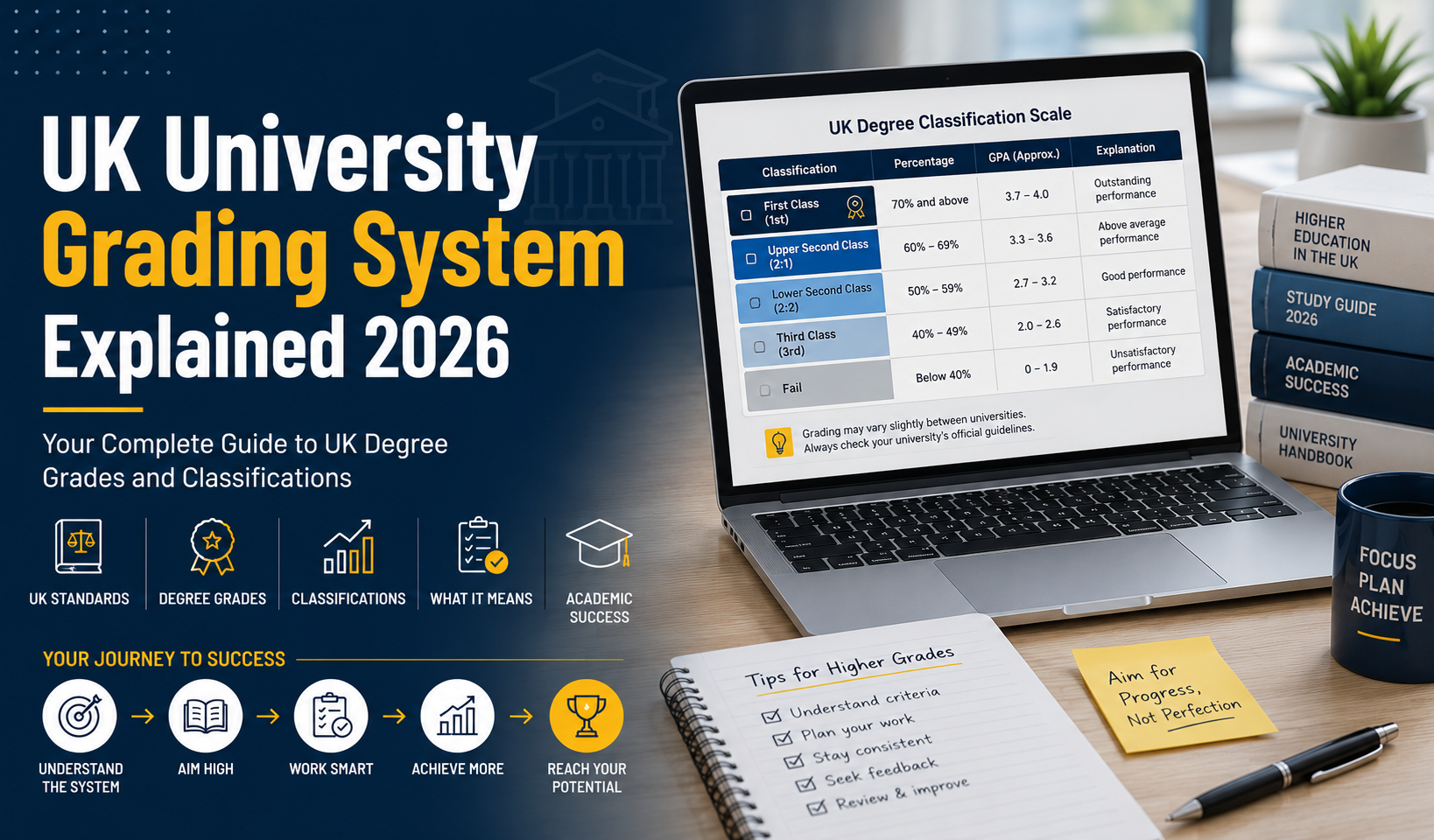
If you are a student studying at a UK university, or if you are thinking about applying to one, understanding the UK university grading system is absolutely essential. Whether you are an undergraduate, a postgraduate, or an international student new to the British education system, the way degrees are classified in the UK can feel confusing at first.
The UK university grading system is different from grading systems used in the United States, Europe, and many other parts of the world. Instead of a simple GPA or percentage score, UK universities award degree classifications that tell employers and postgraduate institutions exactly how well you performed across your entire degree.
In this complete 2026 guide, we are going to break down everything you need to know about the UK university grading system. We will explain what each classification means, how grades are calculated, what employers think of each grade, and most importantly, what you can do if you are struggling to achieve the grade you need.
What Is the UK University Grading System?
The UK university grading system for undergraduate degrees is based on a classification structure that has been used for decades. Rather than awarding a simple pass or fail, UK universities divide degree outcomes into four main classifications.
These classifications are awarded based on your overall academic performance across your degree, usually weighted more heavily towards your final year results. Understanding how the UK university grading system works is the first step towards achieving the grade you are aiming for.
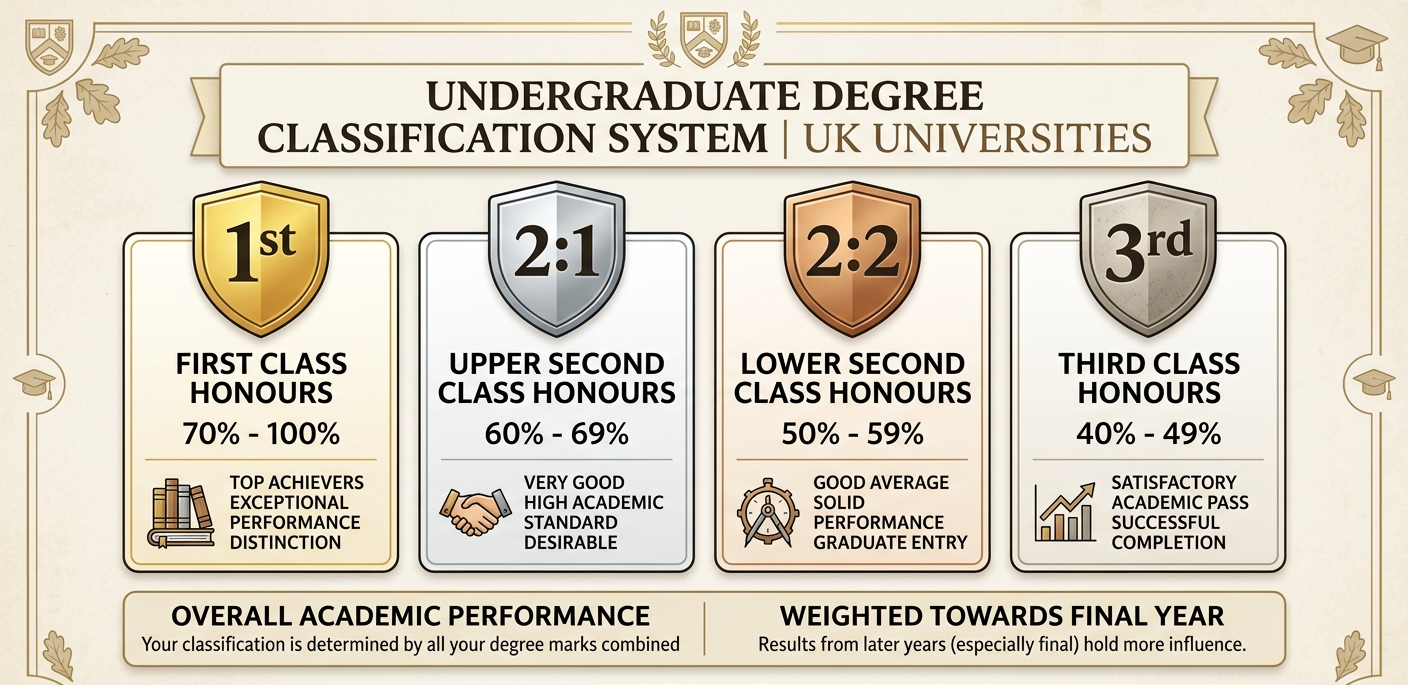
The four main classifications in the UK university grading system are:
First Class Honours, Upper Second Class Honours, Lower Second Class Honours, and Third Class Honours.
Each of these classifications corresponds to a percentage range, and together they make up the entire UK university grading system for undergraduate degrees.
First Class Honours:
A First Class Honours degree, commonly known simply as a First, is the highest classification available in the UK university grading system. To achieve a First, you generally need to achieve an average grade of 70 percent or above across your assessments.
A First Class degree is considered outstanding academic achievement. It signals to employers and postgraduate institutions that you performed at the very top of your academic programme. In recent years, the number of students achieving a First has grown significantly, but it remains the most prestigious classification in the UK university grading system.
If you are aiming for a First and you are struggling with your dissertation, our dissertation writing service can help you understand what first class work looks like and how to get there.
What Does a First Class Degree Get You?
A First Class degree opens the most competitive graduate schemes in the UK. Top employers including law firms, investment banks, consulting firms, and technology companies often use a First as a minimum requirement for their most sought after positions. It also gives you the strongest possible foundation for postgraduate study including Masters degrees and PhD programmes.
Upper Second Class Honours (2:1)
An Upper Second Class Honours degree, known universally in the UK as a 2:1, is the most common degree classification awarded by UK universities. To achieve a 2:1, you generally need to score between 60 and 69 percent on average across your assessments.
In the UK university grading system, a 2:1 is considered a very good degree. It is the benchmark qualification that most graduate employers and postgraduate programmes use as their minimum entry requirement. If a job advertisement or Masters programme says it requires a good honours degree, it almost always means a 2:1 or above.
The vast majority of UK university students aim for a 2:1 as their target grade. It is a realistic but challenging goal that requires consistent hard work across all years of your degree.
If you are on the boundary between a 2:1 and a 2:2, your dissertation can make all the difference. Our dissertation writing service has helped many students push their overall grade from a 2:2 into 2:1 territory by producing outstanding final year work.
Lower Second Class Honours (2:2)
A Lower Second Class Honours degree, known as a 2:2 and often pronounced "two two," is awarded to students who achieve an average grade of between 50 and 59 percent. In the UK university grading system, a 2:2 is still a respectable academic achievement and represents a solid pass.
However, it is worth being aware that some graduate employers and many postgraduate programmes do specify a 2:1 as a minimum requirement. This does not mean a 2:2 is worthless, far from it, but it can limit some options, particularly in highly competitive industries.
Many students who achieve a 2:2 go on to have highly successful careers. Work experience, professional qualifications, and strong personal skills can more than compensate for a 2:2 in many industries including sales, retail management, hospitality, media, and entrepreneurship.
If you are currently on track for a 2:2 and want to push for higher, getting expert help with your final year work is one of the most effective strategies. Our essay writing service and assignment writing service can help you improve your grades in the assessments that matter most.
Third Class Honours (Third or 3rd)
A Third Class Honours degree, commonly called a Third, is awarded to students who achieve an average grade of between 40 and 49 percent. In the UK university grading system, a Third is the lowest honours classification available.
While achieving a Third means you have successfully completed your degree, it is important to be realistic about the fact that it does significantly limit graduate opportunities compared to higher classifications. Some employers do not accept Third Class degrees for graduate scheme applications.
That said, a Third Class degree is still a university degree, and many people with a Third have gone on to build excellent careers. Professional experience, additional qualifications, and strong interview skills can open doors regardless of your degree classification.
Ordinary Degree (Pass)
Below a Third Class Honours sits an Ordinary Degree or Pass. Students who score between 35 and 39 percent on average may be awarded an Ordinary Degree rather than an Honours degree. In the UK university grading system, this is relatively uncommon but does happen.
An Ordinary Degree still represents the completion of a university programme, but without the Honours classification it carries less weight in the graduate job market
How Are UK University Grades Calculated?
One of the most important things to understand about the UK university grading system is how your final degree classification is actually calculated. Different universities use slightly different methods, but the most common approach is a weighted average that places significantly more importance on your final year results.
At most UK universities, your final year typically accounts for around 60 to 70 percent of your overall degree classification. Your second year usually accounts for the remaining 30 to 40 percent. In many cases, your first year results do not count towards your final classification at all, though you must pass to progress.
This weighting system means that your performance in your final year, including your dissertation, is absolutely critical. A strong final year can lift your overall classification even if you struggled in earlier years. This is exactly why so many students invest in getting expert support for their final year work.
Our thesis writing service and research paper service are specifically designed to help final year students produce the highest quality work possible and maximise their degree classification.
UK University Grading System vs Other Countries
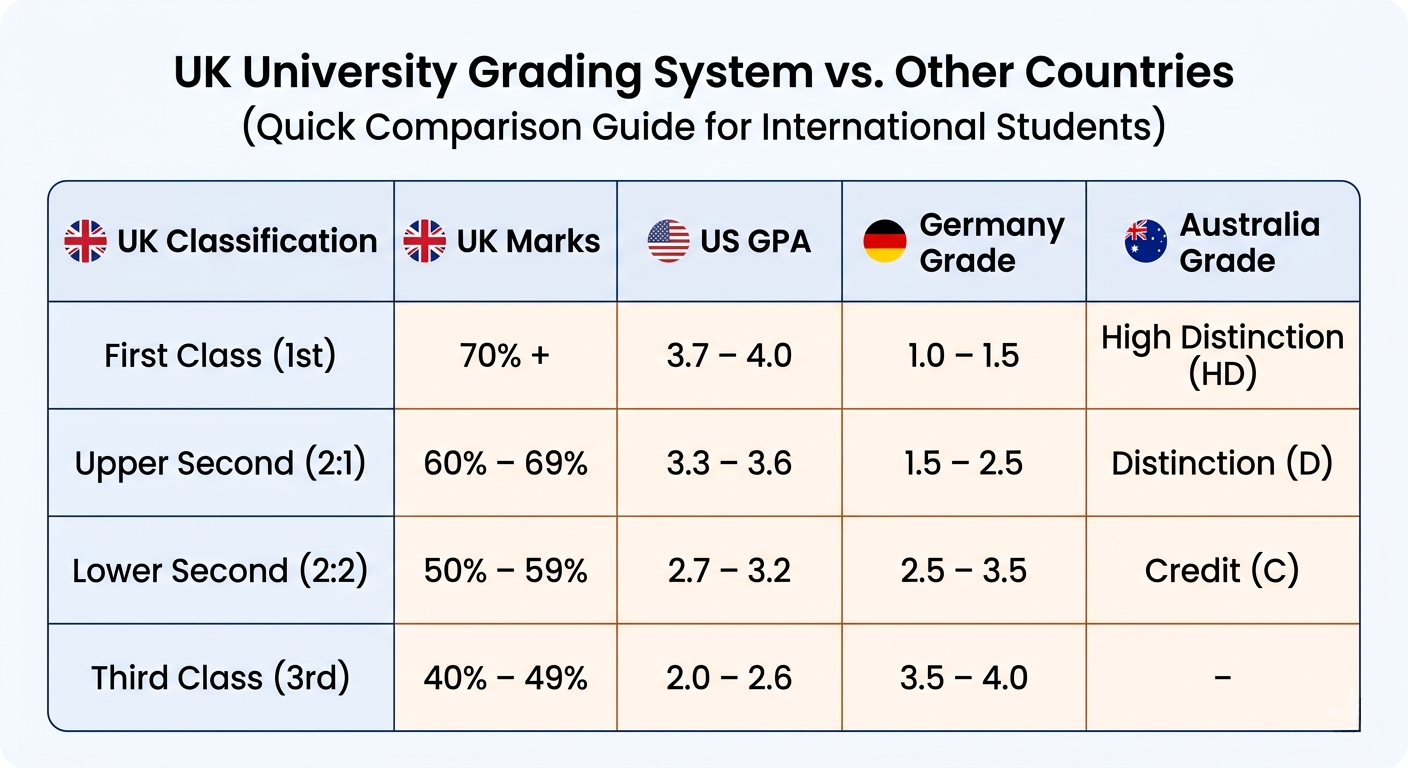
If you are an international student studying in the UK, or a UK student considering postgraduate study abroad, it is useful to understand how the UK university grading system compares to other countries.
UK vs USA
In the United States, universities use a GPA system where 4.0 is the highest possible score. A UK First Class degree is broadly equivalent to a US GPA of 3.7 to 4.0. A UK 2:1 maps roughly to a US GPA of 3.0 to 3.7. A UK 2:2 corresponds approximately to a US GPA of 2.0 to 3.0.
UK vs Europe
Many European countries use a numerical grading scale. In Germany for example, grades run from 1.0 (best) to 5.0 (fail). A UK First is broadly comparable to a German 1.0 to 1.5. A UK 2:1 maps approximately to a German 1.5 to 2.5.
UK vs Australia
Australian universities use High Distinction, Distinction, Credit, and Pass classifications. A UK First broadly corresponds to an Australian High Distinction, while a UK 2:1 maps to an Australian Distinction.
Understanding these equivalencies is particularly important if you are applying for postgraduate programmes or jobs internationally and need to explain your UK qualification to a foreign institution or employer.
What Do Employers Think of Each Grade?
Understanding what employers think of different grades in the UK university grading system can help you set realistic expectations and plan your career accordingly.
Most large UK graduate employers, particularly in finance, law, consulting, and technology, have traditionally set a 2:1 as their minimum entry requirement. Many top employers and prestigious graduate schemes specifically state that they require a 2:1 or above. Some of the most competitive employers, including magic circle law firms and bulge bracket investment banks, may expect a First.
However, attitudes are changing. An increasing number of UK employers have moved away from using degree classification as a filter and instead focus on skills, experience, and potential. Companies including Penguin Random House, PricewaterhouseCoopers, and several major banks have publicly dropped degree classification requirements in recent years.
The key message is this. While a higher classification in the UK university grading system will open more doors, a lower classification does not close them all. What you do alongside your degree, work experience, volunteering, extracurricular activities, and personal development, matters enormously.
How Your Dissertation Affects Your Degree Classification
Your dissertation is almost always one of the most heavily weighted pieces of work in your entire degree. In many UK universities, the dissertation accounts for a significant portion of your final year grade, which in turn accounts for the majority of your overall degree classification.
This means that performing well in your dissertation can be the single most impactful thing you do to improve your position in the UK university grading system. A student who is averaging a 2:2 but produces an outstanding dissertation can push their overall average into 2:1 territory. A student already on a 2:1 who produces exceptional dissertation work may cross the boundary into First Class.
This is why so many UK students seek professional support when writing their dissertation. At Top Dissertation Writers, we have helped hundreds of students produce the standard of dissertation work needed to achieve their target grade. Whether you need a complete dissertation written from scratch or help with a specific chapter, our team of expert UK academic writers is ready to help.
Tips to Improve Your Grade in the UK University Grading System
If you are currently studying and want to improve your position in the UK university grading system, here are some practical tips that can make a real difference.
Understand the Marking Criteria
Every assignment you submit is marked against specific criteria. Read these criteria carefully before you start writing. Understand exactly what your marker is looking for and structure your work accordingly.
Focus on Your Final Year
Because of the weighting system, your final year performance matters most. Prioritise your final year modules and your dissertation above everything else.
Get Feedback and Act on It
Whenever you receive feedback on an assignment, read it carefully and use it to improve your next piece of work. Many students read feedback briefly and then ignore it. Acting on feedback is one of the simplest and most effective ways to improve your grades.
Seek Help Early
If you are struggling with any aspect of your coursework, do not wait until it is too late. Speak to your tutor, visit your university writing centre, or get professional support from our assignment writing service.
Use Quality Academic Sources
UK markers reward students who draw on high quality, relevant, and recent academic literature. Use your university library database to find peer reviewed journal articles rather than relying on general internet sources.
How Much Does Professional Academic Support Cost?
One concern many students have when thinking about getting professional help to improve their grades in the UK university grading system is cost. At Top Dissertation Writers, we are committed to offering high quality support at prices that UK students can afford.
Our pricing is transparent and based on your subject, deadline, and word count. You can view full details on our prices page. We also offer free revisions on all orders, so you can be confident that you will receive work that meets your exact requirements.
We understand that UK students are under significant financial pressure, especially with rising tuition fees and living costs. That is why we work hard to keep our prices fair and accessible.
Conclusion
The UK university grading system is one of the most important things you will encounter during your time as a student in Britain. Understanding the difference between a First, a 2:1, a 2:2, and a Third, and knowing how these classifications are calculated and what they mean for your future, puts you in the best possible position to succeed.
Whether you are just starting your degree or approaching your final year, the decisions you make about how you approach your studies will directly determine where you end up in the UK university grading system. Focus on your final year, take your dissertation seriously, seek help when you need it, and never underestimate the impact that expert support can have on your final grade.
At Top Dissertation Writers, we are here to help UK students at every stage of their academic journey. From dissertations and essays to assignments and research papers, our expert team is ready to help you achieve the grade you deserve. Find out more about us and place your order today.
References
Higher Education Statistics Agency. (2023). Higher education student data. HESA.
Office for National Statistics. (2022). Education and training statistics. ONS.
Quality Assurance Agency for Higher Education. (2021). UK higher education standards. QAA.
Prospects. (2023). Graduate outcomes and earnings. Prospects.
Google Scholar. (2024). Academic publishing trends. Scholar.
Comments (0)
Leave a Comment