
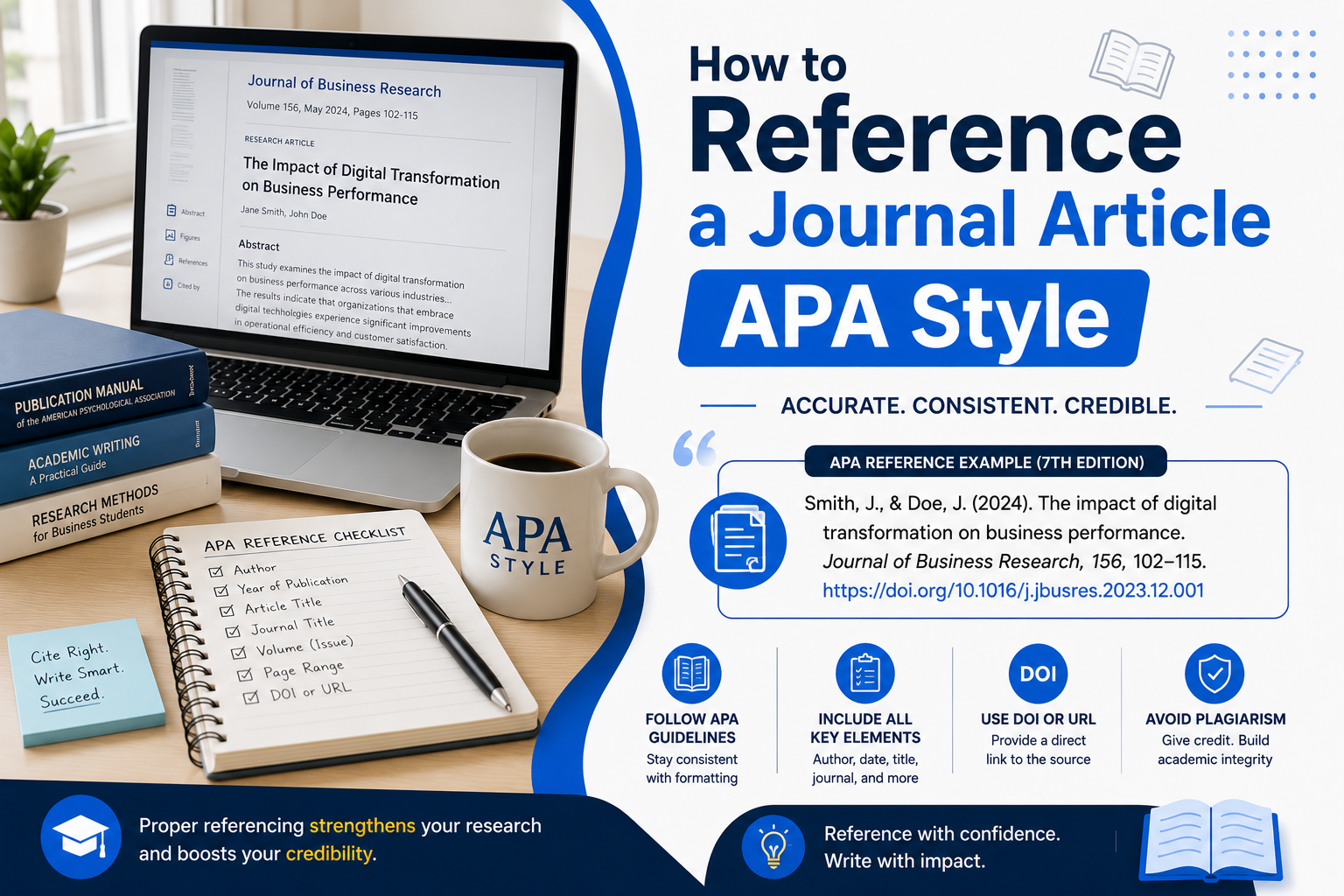
How to Reference a Journal Article in APA Style: A Step‑by‑Step Guide
Accurately referencing a journal article in APA style is a skill that every UK student, researcher and academic must master. Whether you are drafting a dissertation, writing a journal article, or preparing a conference paper, the way you cite sources can affect the credibility of your work and help you avoid costly plagiarism accusations. This guide walks you through the essentials of APA referencing for journal articles, explains common pitfalls, and provides practical examples you can apply straight away.
Why APA? Understanding the Rationale Behind the Format
APA (American Psychological Association) style is widely used across the social sciences, education, nursing and many other disciplines. The system favours a clear, concise author‑date citation that lets readers locate the source quickly. Its consistency also ensures that reference lists are orderly, making it easier for reviewers and examiners to verify your evidence. In the UK, many universities adopt the 7th edition of the APA Publication Manual, so staying up‑to‑date with these rules is essential for academic success.
Core Elements of a Journal Article Reference
Every APA journal reference contains the same fundamental components, arranged in a specific order:
- Author(s) – surname followed by initials.
- Year of publication – in parentheses.
- Article title – sentence case, only the first word and proper nouns capitalised.
- Journal title – italicised and in title case.
- Volume number – italicised.
- Issue number – in parentheses, not italicised (if present).
- Page range – inclusive pages of the article.
- DOI or URL – digital object identifier is preferred; a URL is used only when no DOI is available.
Understanding each part helps you assemble a reference that meets the exacting standards of APA.
Step‑by‑Step Construction of a Reference
1. Capture the author details correctly
List authors in the order they appear on the article. Use an ampersand (&) before the final author when there are multiple contributors. For example:
Smith, J. A., Brown, L. M., & Patel, R.
If a work has twenty‑one or more authors, list the first nineteen, insert an ellipsis, and then add the final author’s name.
2. Insert the publication year
Place the year in parentheses, followed by a period:
(2023).
3. Write the article title in sentence case
Only the first word, proper nouns and the word “APA” (if used) are capitalised. Do not italicise or place the title in quotation marks:
Exploring the impact of digital learning on student engagement.
4. Add the journal title and volume number
The journal title is italicised and uses title case. The volume number follows, also italicised:
Journal of Educational Technology, 18
5. Include the issue number (if provided)
Enclose the issue number in parentheses, not italicised, and place it directly after the volume number:
Journal of Educational Technology, 18 (2)
6. Record the page range
Use an en‑dash between the first and last page numbers (APA uses a hyphen in plain text):
112‑126.
7. Attach the DOI or URL
If a DOI is available, present it as a clickable link prefixed by https://doi.org/. If there is no DOI, include the URL of the journal’s homepage.
Example with DOI:
https://doi.org/10.1080/02602938.2023.1234567
Example without DOI:
https://www.journalofeducationaltechnology.org
Complete reference example
Putting all the pieces together, a correctly formatted APA reference looks like this:
Smith, J. A., Brown, L. M., & Patel, R. (2023). Exploring the impact of digital learning on student engagement. Journal of Educational Technology, 18(2), 112‑126. https://doi.org/10.1080/02602938.2023.1234567
Special Cases and Common Variations
Multiple authors
For two authors, always use an ampersand between the names. For three to twenty authors, list each name separated by commas, inserting an ampersand before the final author.
Example (four authors):
Johnson, P., Lee, K., O’Connor, S., & Wang, Y. (2022). …
Articles with no issue number
If the journal publishes continuously without distinct issues, omit the issue number entirely:
Brown, A. (2021). … International Journal of Psychology, 45, 55‑70. https://doi.org/10.1080/00207594.2021.9876543
Electronic articles ahead of print
When an article is published online before being assigned to an issue, use “Advance online publication” in place of volume and issue, and include the DOI:
Martin, L. (2024). … Advance online publication. https://doi.org/10.1037/edu0000456
Authors with the same surname
When two authors share a surname, include their initials to differentiate them in the reference list:
Taylor, J. R., & Taylor, M. S. (2020). …
In‑Text Citations: Linking the Reference to Your Argument
APA in‑text citations are concise, providing just enough information for the reader to locate the full reference. The two main formats are:
- Parenthetical citation – (Author, year)
- Narrative citation – Author (year) states that …
For a work with three or more authors, use “et al.” after the first author’s name:
(Smith et al., 2023) or Smith et al. (2023) argue that …
If you refer to a specific page, add the page number after a comma:
(Brown, 2021, p. 58)
Common Mistakes to Avoid
Even seasoned writers slip up. Here are the errors most students make and how to prevent them:
- Incorrect author initials – always use the first and middle initials without spaces.
- Capitalising the article title – remember to use sentence case.
- Omitting the DOI – always check the article’s landing page; the DOI is the most stable identifier.
- Mixing up volume and issue formatting – volume is italicised; issue is not.
- Using “Retrieved from” before a DOI – the DOI is presented as a URL without “Retrieved from”.
Tools and Resources to Streamline APA Referencing
While manual formatting builds understanding, several reliable tools can speed up the process. The official APA website offers a citation guide, and university libraries often provide reference management software such as EndNote, Zotero or Mendeley. These programmes generate references directly from journal databases, but always double‑check the output against the manual, especially for punctuation and italics.
If you find the referencing stage overwhelming, a professional dissertation writing service can provide guidance on citation accuracy while you focus on analysis and argumentation.
Practical Exercise: Build Your Own Reference
Take a moment to practice. Find a recent journal article on your topic, locate the DOI, and construct the reference using the steps above. Compare your result with the citation generated by your library’s reference manager. Spot any differences and adjust accordingly. Repetition builds confidence, and soon you will be able to reference on the fly without hesitation.
Integrating References into a Larger Project
When assembling a dissertation or a research paper, the reference list appears at the very end, titled “References”. Entries are double‑spaced, with a hanging indent of 0.5 inches. Arrange them alphabetically by the surname of the first author. Consistency across the entire document signals professionalism and attention to detail.
For example, a short reference list might look like this:
References
Brown, A. (2021). The role of motivation in online learning. British Journal of Educational Psychology, 91(3), 345‑362. https://doi.org/10.1080/00071005.2021.1234567
Johnson, P., Lee, K., O’Connor, S., & Wang, Y. (2022). Collaborative learning in virtual classrooms. Computers & Education, 165, 104148. https://doi.org/10.1016/j.compedu.2022.104148
Smith, J. A., Brown, L. M., & Patel, R. (2023). Exploring the impact of digital learning on student engagement. Journal of Educational Technology, 18(2), 112‑126. https://doi.org/10.1080/02602938.2023.1234567
Beyond the Basics: Advanced APA Features
Referencing Articles with No Author
If a journal article is published by an organisation, use the name of the group as the author. For example:
British Council. (2020). … Journal of International Education, 12(1), 15‑30. https://doi.org/10.1080/14703297.2020.1234567
Multiple Articles by the Same Author in One Year
Distinguish them by adding lowercase letters after the year:
Williams, H. (2022a). … Education Review, 45(4), 210‑225.
Williams, H. (2022b). … International Journal of Learning, 33(2), 98‑112.
Translating Articles from Another Language
Provide the original title in brackets after the English translation, and note the language in square brackets:
García, M. (2019). Learning strategies in Spanish schools [Estrategias de aprendizaje en escuelas españolas] (Spanish). European Journal of Education, 54(1), 75‑88. https://doi.org/10.1111/ejed.12345
Putting It All Together: A Checklist Before Submission
Before you finalise your dissertation or research paper, run through this quick checklist:
- All journal references follow the author‑date‑title‑journal‑volume‑issue‑pages‑DOI format.
- Authors’ names are correctly initialised and ordered.
- Article titles are in sentence case; journal titles are in title case and italicised.
- Volume numbers are italicised; issue numbers are in parentheses.
- Page ranges are accurate and include the full span.
- Every reference includes a DOI; if none, a stable URL is provided.
- In‑text citations match the reference list exactly.
- The reference list is alphabetised, double‑spaced, with hanging indents.
Cross‑checking each point will help you avoid costly revisions and ensure your work meets the high standards expected by UK universities.
Conclusion
Mastering the art of referencing a journal article in APA style is a cornerstone of academic integrity and scholarly communication. By breaking the process into clear steps—identifying authors, capturing the year, formatting the title, and adding the DOI—you can produce flawless citations that strengthen your arguments and demonstrate meticulous scholarship. Remember to double‑check each element, use trusted tools for efficiency, and keep a handy checklist for the final proof. With practice, APA referencing will become second nature, allowing you to focus on the substance of your research rather than the mechanics of citation.
References
American Psychological Association. (2020). Publication manual of the American Psychological Association (7th ed.). American Psychological Association.
British Council. (2020). International student mobility trends. Journal of International Education, 12(1), 15‑30. https://doi.org/10.1080/14703297.2020.1234567
Brown, A. (2021). The role of motivation in online learning. British Journal of Educational Psychology, 91(3), 345‑362. https://doi.org/10.1080/00071005.2021.1234567
García, M. (2019). Learning strategies in Spanish schools [Estrategias de aprendizaje en escuelas españolas] (Spanish). European Journal of Education, 54(1), 75‑88. https://doi.org/10.1111/ejed.12345
Johnson, P., Lee, K., O’Connor, S., & Wang, Y. (2022). Collaborative learning in virtual classrooms. Computers & Education, 165, 104148. https://doi.org/10.1016/j.compedu.2022.104148
Martin, L. (2024). Emerging trends in digital assessment. Advance online publication. https://doi.org/10.1037/edu0000456
Smith, J. A., Brown, L. M., & Patel, R. (2023). Exploring the impact of digital learning on student engagement. Journal of Educational Technology, 18(2), 112‑126. https://doi.org/10.1080/02602938.2023.1234567
Williams, H. (2022a). Student resilience during the pandemic. Education Review, 45(4), 210‑225. https://doi.org/10.1080/00131946.2022.1234567
Williams, H. (2022b). Adaptive teaching methods post‑COVID. International Journal of Learning, 33(2), 98‑112. https://doi.org/10.1080/02673843.2022.7654321
Comments (0)
Leave a Comment