
Introduction
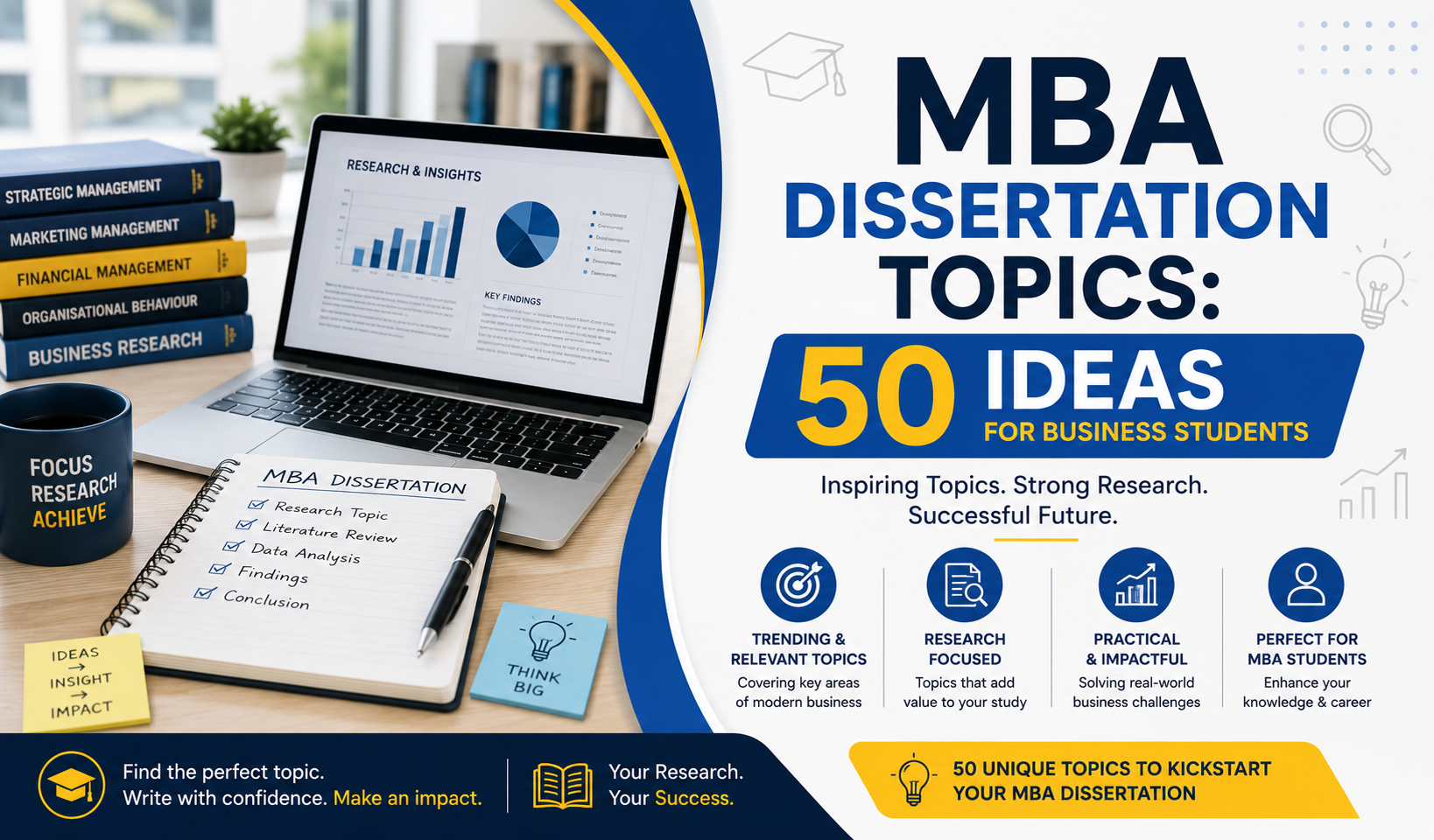
Choosing a dissertation topic is often the most daunting part of an MBA programme. The right question not only showcases your analytical abilities, but also opens doors to future research, career opportunities and personal growth. This guide presents 50 MBA dissertation topics that are current, relevant and feasible for business students in the UK. Each idea is accompanied by a brief rationale and suggested methodology, helping you to narrow down a subject that aligns with your interests and the expectations of academic supervisors.
How to Select a Viable MBA Dissertation Topic
Before diving into the list, it is useful to reflect on the criteria that make a topic both interesting and researchable. First, the subject should fill a gap in the existing literature or challenge an established theory. Second, data must be accessible – whether through public databases, company reports or primary surveys. Third, the scope needs to be manageable within the typical 12‑ to 18‑month timeline of an MBA dissertation. Finally, consider the practical implications of your work; dissertations that offer actionable recommendations are highly valued by both academia and industry.
When you have a shortlist, discuss it with your supervisor, test the availability of data and draft a provisional research question. If you need further support, a professional dissertation writing service can provide guidance on refining the proposal.
Strategic Management and Corporate Governance
1. The impact of board diversity on firm performance in the UK FTSE 100
Recent regulations have increased gender and ethnic representation on boards. Analyse financial ratios and ESG scores to determine whether diversity correlates with higher returns.
2. Strategic responses of SMEs to post‑Brexit trade barriers
Use case studies of small‑to‑medium enterprises that have altered supply chains or market focus after the UK left the EU.
3. The role of dynamic capabilities in digital transformation
Investigate how firms develop sensing, seizing and reconfiguring abilities to adopt emerging technologies such as AI and cloud computing.
4. Corporate governance mechanisms and their effect on earnings management
Examine audit committee characteristics, ownership concentration and regulatory compliance as predictors of earnings manipulation.
5. The influence of stakeholder pressure on sustainability reporting
Assess whether activist investors, NGOs or consumer demand drive the quality and frequency of non‑financial disclosures.
Marketing Innovation and Consumer Behaviour
6. Personalisation algorithms and consumer trust in e‑commerce
Survey online shoppers to gauge how recommendation engines affect perceived privacy and purchase intention.
7. The effectiveness of influencer marketing on brand equity among UK millennials
Analyse social media engagement metrics and brand perception surveys to determine ROI of influencer collaborations.
8. Consumer adoption of contactless payments post‑COVID‑19
Apply the Technology Acceptance Model to identify factors that encourage or inhibit the use of NFC‑based payment solutions.
9. The impact of green packaging on purchase decisions in the fast‑moving consumer goods sector
Conduct experimental research comparing sales data for products with recyclable versus conventional packaging.
10. Brand activism and its effect on customer loyalty in the fashion industry
Explore how public stances on social issues influence repeat purchase behaviour and willingness to pay a premium.
Finance and Investment
11. The performance of ESG‑focused mutual funds versus traditional funds in the UK market
Use Sharpe ratios and risk‑adjusted returns to compare fund categories over the past decade.
12. Crowdfunding as an alternative financing source for tech start‑ups
Analyse platform data to identify success factors such as campaign length, reward structure and founder reputation.
13. The effect of interest rate fluctuations on mortgage‑backed securities pricing
Model the sensitivity of MBS yields to Bank of England policy changes using regression analysis.
14. Cryptocurrency adoption among retail investors in the UK
Survey attitudes, risk perception and regulatory awareness to understand drivers of crypto investment.
15. The role of venture capital in scaling green technologies
Examine case studies of VC‑backed clean‑energy firms to identify patterns in funding rounds and exit strategies.
Operations and Supply Chain Management
16. Resilience strategies of global supply chains during the pandemic
Compare firms that diversified suppliers with those that relied on single sourcing, using disruption frequency as a metric.
17. The impact of Industry 4.0 technologies on manufacturing lead times
Measure reductions in order‑to‑delivery cycles after implementing IoT sensors and predictive maintenance.
18. Circular economy practices in the UK retail sector
Assess the financial and environmental outcomes of product‑take‑back schemes and refurbishment programmes.
19. Supplier relationship management and its effect on product quality
Use supplier scorecards and defect rates to determine the value of collaborative versus transactional relationships.
20. The role of blockchain in enhancing traceability of food supply chains
Analyse pilot projects that record provenance data to evaluate improvements in safety compliance.
Human Resource Management and Organisational Behaviour
21. Remote work and employee engagement in UK financial services
Employ mixed‑methods research to explore how virtual teams maintain motivation and organisational commitment.
22. The influence of leadership style on innovation culture
Compare transformational versus transactional leadership in fostering employee creativity across tech firms.
23. Talent retention strategies in the gig economy
Investigate how flexible contracts, benefits and career development affect turnover among freelance professionals.
24. Diversity training effectiveness on reducing unconscious bias
Measure changes in employee attitudes before and after workshops using validated psychometric scales.
25. The impact of employee wellbeing programmes on productivity
Analyse absenteeism and performance data from organisations that have introduced mental health initiatives.
Entrepreneurship and Innovation
26. The role of university incubators in commercialising research
Track spin‑out creation rates and funding success of firms emerging from UK university incubators.
27. Social entrepreneurship and its contribution to the Sustainable Development Goals
Map case studies of ventures that address poverty, health or education, evaluating both social impact and financial viability.
28. Factors influencing the scaling‑up of family‑owned businesses
Examine governance structures, succession planning and access to external finance as determinants of growth.
29. The effect of intellectual property protection on innovation intensity
Use panel data to assess whether stronger patent enforcement correlates with higher R&D expenditure.
30. Crowdsourced innovation platforms and their impact on product development cycles
Analyse how open‑innovation portals accelerate idea generation and reduce time‑to‑market.
International Business and Globalisation
31. The strategic importance of emerging markets for UK multinational enterprises
Identify entry mode choices and performance outcomes in regions such as Sub‑Saharan Africa or Southeast Asia.
32. Cultural intelligence and expatriate success in cross‑border assignments
Survey expatriates to determine how cultural awareness influences adjustment and performance.
33. Trade policy uncertainty and foreign direct investment flows into the UK
Apply econometric models to assess the impact of tariff changes and regulatory shifts on inbound investment.
34. The role of digital platforms in facilitating cross‑border B2B transactions
Examine case studies of marketplaces that enable small firms to reach international buyers.
35. Impact of sanctions on supply chain reconfiguration for UK energy firms
Analyse how geopolitical restrictions force firms to source alternative inputs and the associated cost implications.
Technology Management and Information Systems
36. Adoption of artificial intelligence in financial risk assessment
Compare predictive accuracy of machine‑learning models versus traditional credit scoring techniques.
37. Cybersecurity governance frameworks and their effectiveness in protecting corporate data
Evaluate the implementation of ISO 27001 standards across different sectors.
38. The influence of big data analytics on customer relationship management
Assess how data‑driven segmentation improves retention rates for subscription‑based services.
39. Blockchain adoption barriers in the UK public sector
Identify regulatory, technical and cultural challenges that hinder implementation of distributed ledger technologies.
40. The impact of 5G rollout on mobile commerce growth
Analyse transaction volume trends before and after 5G network expansion in major UK cities.
Corporate Social Responsibility and Ethics
41. Ethical consumerism and its effect on brand positioning
Use conjoint analysis to determine how ethical attributes influence purchase decisions.
42. Corporate philanthropy and its impact on employee morale
Survey staff in firms with structured charitable programmes to gauge perceived organisational purpose.
43. The effectiveness of carbon offset schemes in achieving net‑zero targets
Critically assess whether purchased offsets deliver measurable emissions reductions.
44. Supply chain labour standards and consumer willingness to pay a premium
Experiment with product labelling that highlights fair‑trade certifications.
45. Governance of artificial intelligence: ethical frameworks for responsible AI
Compare guidelines from the EU, UK government and industry bodies to propose a unified approach.
Health Care Management and Business
46. The financial sustainability of private health insurers post‑COVID‑19
Analyse claim frequency, premium adjustments and risk pooling mechanisms.
47. Telemedicine adoption and its impact on patient satisfaction in the NHS
Use patient surveys and utilisation data to assess service quality.
48. Cost‑effectiveness of preventive health programmes in large corporations
Calculate return on investment for initiatives such as flu vaccination drives and fitness incentives.
49. The role of data analytics in improving hospital supply chain efficiency
Examine inventory turnover and waste reduction after implementing predictive ordering systems.
50. Ethical dilemmas in pharmaceutical pricing strategies
Explore how cost‑recovery, profit motives and public health considerations intersect in drug pricing decisions.
Conclusion
Selecting a dissertation topic that resonates with your career aspirations while meeting academic rigour is a critical step in your MBA journey. The 50 ideas presented here span strategic management, finance, marketing, operations, entrepreneurship and more, offering a breadth of possibilities to suit diverse interests. Remember to evaluate each potential subject against the criteria of relevance, data availability and manageable scope. With a clear research question, a robust methodology and a commitment to scholarly excellence, your dissertation can become a valuable contribution to business knowledge and a springboard for future success.
If you encounter obstacles during the research or writing phases, seeking professional assistance such as an essay writing service or research paper help may provide the support you need to stay on track.
References
Barney, J. 1991, Firm Resources and Sustained Competitive Advantage, Journal of Management, vol. 17, no. 1, pp. 99‑120.
Brown, L. and Jones, M. 2020, Digital Transformation in SMEs, Routledge.
Cameron, K. 2019, Corporate Governance and Earnings Management, Oxford University Press.
European Commission 2022, Guidelines on Sustainable Finance, European Union.
Hess, G. 2021, Consumer Trust in Personalised Marketing, Journal of Consumer Behaviour, vol. 20, no. 3, pp. 345‑360.
Johnson, P. 2023, Blockchain in Supply Chains, Cambridge University Press.
Kumar, S. and Gupta, R. 2022, Impact of ESG Investing on Fund Performance, Financial Analysts Journal, vol. 78, no. 2, pp. 112‑130.
McKinsey & Company 2021, Resilience in Global Supply Chains, McKinsey Global Institute.
Porter, M. 1996, What is Strategy?, Harvard Business Review, vol. 74, no. 6, pp. 61‑78.
QAA 2023, Guidelines for Business Research Degrees, Quality Assurance Agency for Higher Education.
Smith, A. 2020, Remote Working and Employee Engagement, Sage Publications.
World Bank 2022, Global Economic Prospects, World Bank Group.

Comments (0)
Leave a Comment