
Dissertation vs Thesis: What’s the Difference?
When you first encounter the terms “dissertation” and “thesis” you might assume they are interchangeable, but the reality is far more nuanced. Understanding the distinction between a dissertation and a thesis is essential whether you are embarking on a postgraduate journey in the UK, planning to study abroad, or simply trying to make sense of academic expectations. In this guide I will walk you through the key differences, the typical structures, and the purposes each document serves, so you can approach your research with confidence.
Historical Roots and Regional Variations
The words “dissertation” and “thesis” have Latin origins, both referring to a “treatise” or “statement of theory”. Over centuries their meanings have diverged, largely because of differing academic traditions. In the United Kingdom and many Commonwealth countries a dissertation is usually associated with a research‑based master’s degree, while a thesis is the hallmark of a doctoral (PhD) programme. In the United States the opposite is often true: a thesis is submitted for a master’s degree and a dissertation for a PhD. This reversal creates confusion for international students, but the underlying principle remains the same – the document reflects the level of originality and depth expected at that stage of study.
Purpose and Scope
What a Dissertation Aims to Achieve
A dissertation is typically a substantial piece of independent research that demonstrates your ability to engage with existing literature, apply appropriate methodologies, and contribute a modest original insight to your field. The emphasis is on showing that you can conduct a systematic investigation, analyse data, and discuss findings coherently. While originality is valued, the contribution does not need to be groundbreaking; it should nevertheless reflect critical thinking and scholarly rigour.
What a Thesis Aims to Achieve
A thesis, on the other hand, is expected to make a significant, novel contribution to knowledge. Doctoral candidates must identify a gap in the literature, develop a research question that addresses that gap, and generate findings that advance theory, practice, or both. The scope is broader, the analysis deeper, and the argument more sophisticated. In essence, a thesis should be publishable in a reputable academic journal once revised.
Length and Structure
There is no hard‑and‑fast rule about word count, but typical ranges provide useful guidance. A master’s dissertation in the UK often runs between 12,000 and 20,000 words, whereas a PhD thesis can exceed 80,000 words, sometimes reaching 100,000 depending on the discipline. Humanities theses tend toward the higher end, while engineering or scientific theses may be shorter but include extensive appendices of data or code.
The basic structure of both documents shares common elements – introduction, literature review, methodology, results, discussion, and conclusion – but the depth of each section varies. For a dissertation, the literature review might summarise the main debates, whereas a thesis will critically evaluate those debates and position the research within a precise scholarly niche.
Research Supervision and Assessment
Both dissertations and theses are supervised by academic staff, but the relationship differs in intensity. Dissertation supervision usually involves a series of meetings over a year, focusing on guiding the student through research design and writing. For a thesis, supervision is more intensive, often extending over three to four years, with regular progress reports and formal milestones such as the viva voce (oral defence).
Assessment methods also diverge. Dissertations are commonly evaluated by a single examiner or a small panel, and the outcome is a grade (e.g., Distinction, Merit, Pass). A thesis requires a viva, during which external examiners question the candidate about methodology, findings, and implications. The viva can result in a pass, a pass with corrections, or, in rare cases, a fail.
Choosing the Right Path: When to Pursue a Dissertation or a Thesis
If you are enrolling in a taught master’s programme, a dissertation will be your capstone project. It offers a chance to explore a topic of personal interest while developing research skills that are transferable to employment or further study. If your ambition is to become an independent researcher, a PhD thesis is the logical next step, providing the platform to establish yourself as an expert in a specialised area.
It is worth noting that some universities now offer integrated master‑by‑research routes where the dissertation is a stepping stone to a PhD. In such cases, the dissertation may be extended and re‑worked into a thesis, blurring the lines between the two formats.
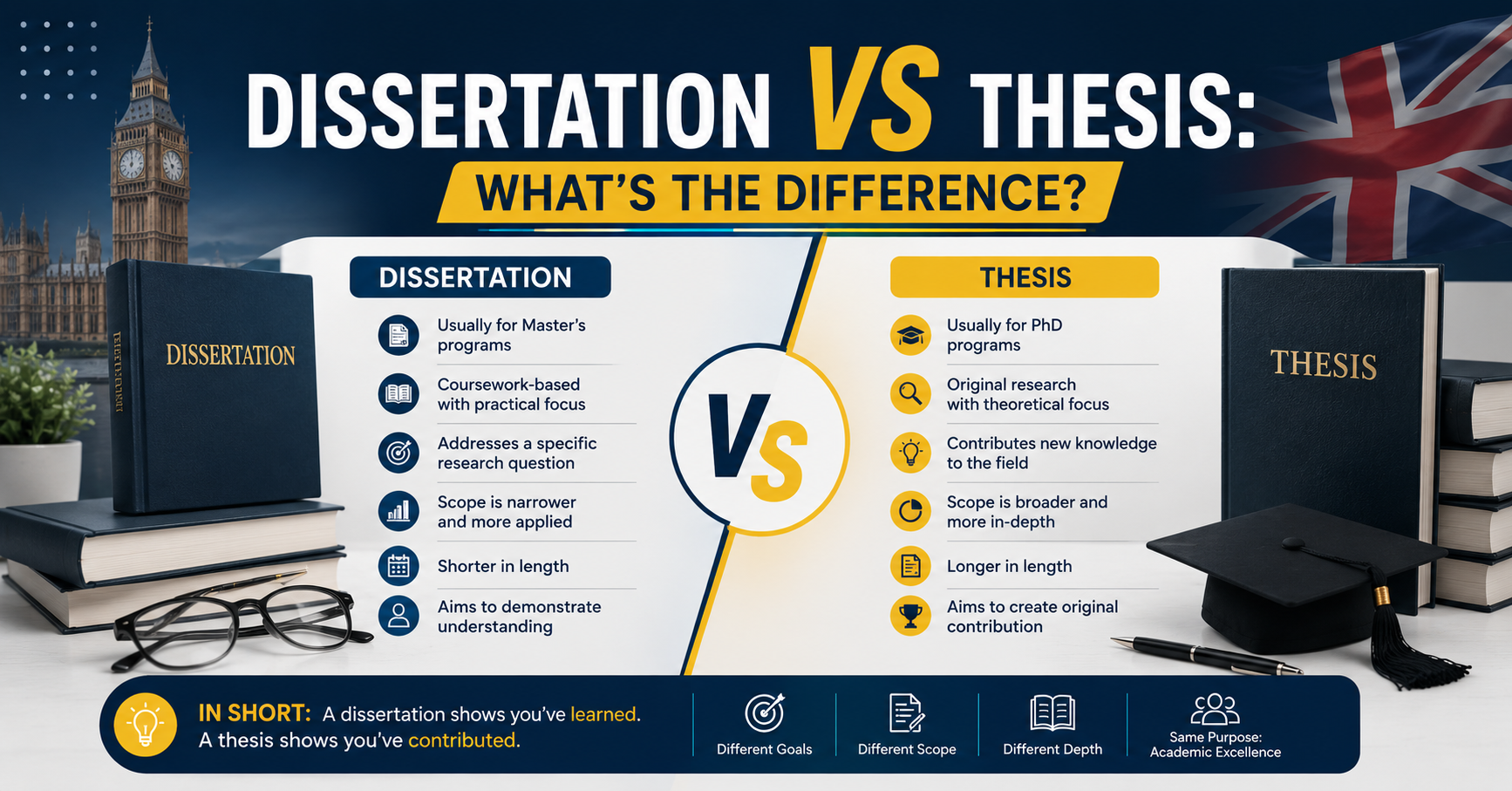
Key Differences at a Glance
Below is a concise comparison that highlights the most salient contrasts:
- Level of study: Dissertation – master’s; Thesis – doctoral.
- Original contribution: Modest for dissertation; substantial for thesis.
- Typical word count: 12‑20k for dissertation; 80‑100k for thesis.
- Assessment: Graded report for dissertation; viva and possible revisions for thesis.
- Supervision intensity: Periodic meetings for dissertation; ongoing guidance for thesis.
Practical Tips for Writing a Successful Dissertation
Even though a dissertation is less demanding than a thesis, it still requires disciplined planning. Here are some strategies that have helped my students achieve strong results:
Start by narrowing your topic early. A focused research question prevents the project from becoming unwieldy. Conduct a systematic literature review using databases such as Google Scholar and keep a detailed spreadsheet of sources, themes, and gaps.
Choose a methodology that aligns with your question. Whether you adopt a qualitative case study, a quantitative survey, or a mixed‑methods approach, justify your choice with reference to established research designs.
Set realistic milestones. Break the dissertation into manageable chunks – proposal, data collection, analysis, drafting – and allocate specific weeks to each. Regularly share drafts with your supervisor and act on feedback promptly.
If you encounter writer’s block or time pressure, consider seeking external help. A reputable dissertation writing service can provide guidance on structure, citation style, and proofreading, ensuring your work meets academic standards without compromising originality.
Essential Advice for Doctoral Candidates Working on a Thesis
Writing a thesis is a marathon, not a sprint. The following recommendations are drawn from years of supervising PhD students across the social sciences and humanities:
Develop a clear research agenda from the outset. Map the theoretical landscape, identify the precise gap you intend to fill, and articulate your contribution in a single sentence. This “elevator pitch” will keep you focused throughout the research process.
Maintain a rigorous data management plan. Whether you are handling archival documents, interview transcripts, or experimental data, organise files systematically and back them up regularly. This habit saves countless hours when you need to retrieve specific excerpts for analysis.
Engage with the scholarly community early. Present preliminary findings at conferences, publish conference papers, and seek feedback from peers. These interactions sharpen your argument and often reveal methodological refinements you might have missed.
Prepare for the viva by rehearsing your defence with colleagues. Anticipate tough questions about limitations, theoretical framing, and future research directions. A well‑prepared candidate can turn the viva into an opportunity to showcase the depth of their scholarship.
Common Misconceptions Debunked
My dissertation will automatically become a thesis if I add more data. Not exactly. While expanding a dissertation can lay the groundwork for a thesis, the latter demands a fundamentally new research question or a substantially deeper theoretical contribution.
Only PhD candidates need to worry about referencing styles. Accurate citation is vital at every level of postgraduate study. Master’s programmes often require strict adherence to Harvard or APA style, and any lapse can affect your grade.
All dissertations are purely literature‑based. Some master’s programmes, especially in the sciences, require original empirical work. Always check your programme handbook for specific expectations.
Resources and Further Reading
For up‑to‑date guidance on UK postgraduate research, consult the Quality Assurance Agency website and the national statistics on higher education available from HESA. The UK government also publishes funding information for doctoral candidates, which can be invaluable when planning your PhD journey.
Many universities provide detailed handbooks on dissertation and thesis preparation. These documents often include templates, exemplar chapters, and timelines that can be customised to your own project.
Conclusion: Making an Informed Choice
Understanding the difference between a dissertation and a thesis is more than an academic exercise; it shapes how you plan your research, allocate your time, and set realistic expectations for your postgraduate experience. A dissertation offers a structured, manageable way to demonstrate research competence at the master’s level, while a thesis challenges you to push the boundaries of knowledge and emerge as an expert in your field.
Whichever path you follow, remember that clear planning, regular supervision, and diligent writing are the cornerstones of success. If you find yourself stuck at any stage, seeking professional advice – whether through a qualified essay writing service for feedback on academic style or specialised thesis writing help – can provide the extra push you need to finish confidently.
References
British Educational Research Association, 2022, Guidelines for postgraduate research, BERA Press.
Higher Education Statistics Agency, 2023, Student enrolment and qualifications in the UK, HESA.
Quality Assurance Agency, 2021, Standards and guidelines for doctoral research, QAA.
University of Oxford, 2020, Doctoral thesis handbook, Oxford University Press.


Comments (0)
Leave a Comment