
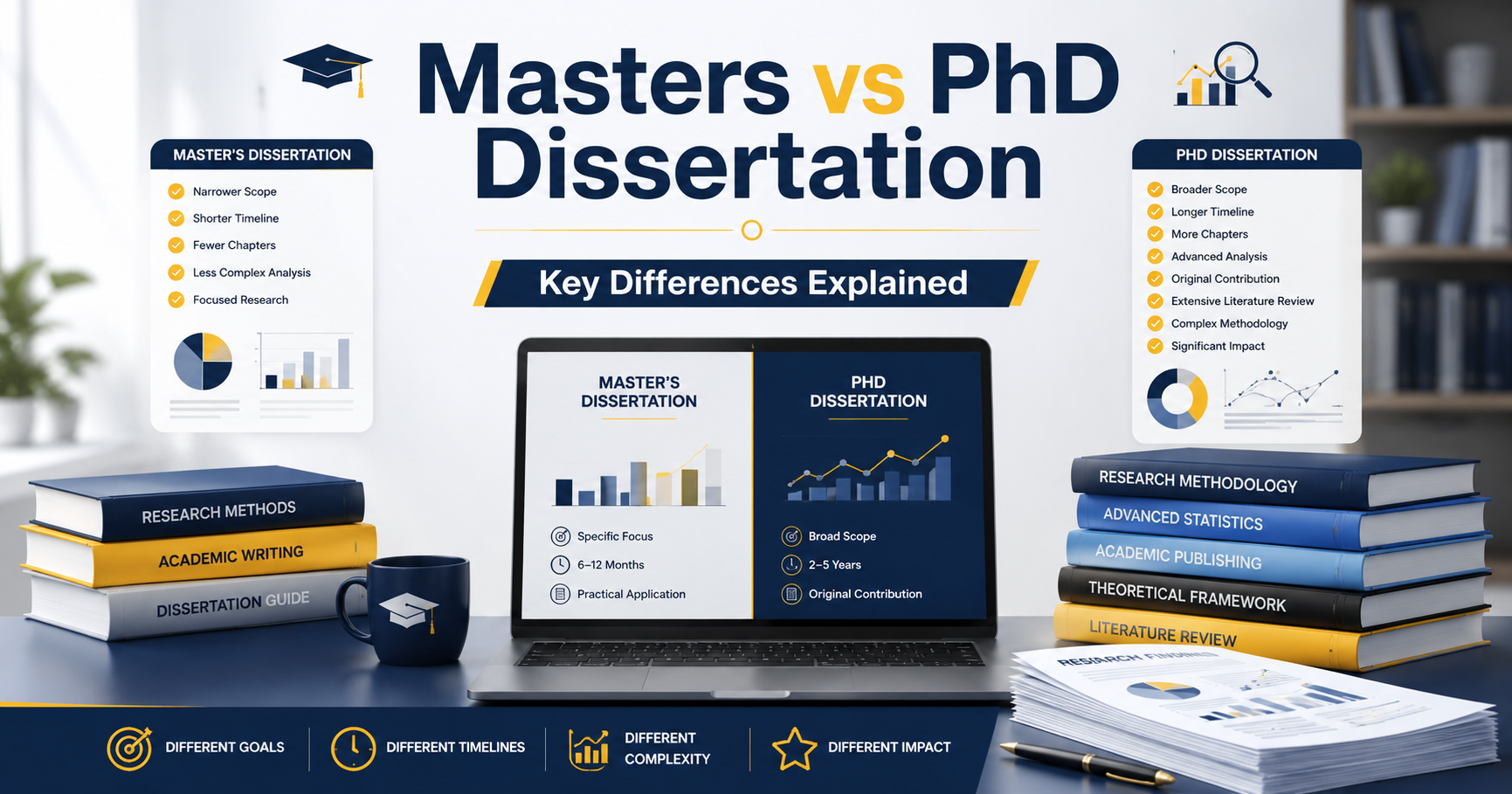
Introduction
Choosing between a master’s dissertation and a PhD thesis is a pivotal decision for any researcher embarking on an advanced academic journey. While both pieces of work share the common goal of contributing to knowledge, they differ markedly in scope, depth, methodology, and the expectations placed upon the writer. Understanding these differences is essential not only for prospective students but also for supervisors, academic committees, and anyone seeking professional dissertation, essay or assignment help. In this article, we unpack the key distinctions between a master’s dissertation and a PhD dissertation, offering clear guidance for those aiming to excel at the highest level of scholarly writing.
1. Purpose and Aim of the Research
Master’s Dissertation
A master’s dissertation is designed to demonstrate a student’s ability to conduct independent research, critically engage with existing literature, and apply appropriate methods to answer a specific research question. The primary aim is to show competence in scholarly practice rather than to produce original, groundbreaking knowledge.
PhD Dissertation
In contrast, a PhD dissertation must make a novel contribution to the field. It should advance theory, develop new methodologies, or provide fresh empirical insights that were previously unavailable. The expectation is that the research will be of publishable quality and will position the candidate as an emerging expert.
2. Scope and Depth
Scale of Investigation
- Master’s level: Typically focuses on a narrowly defined topic, often limited to a single case study, dataset, or theoretical framework.
- PhD level: Encompasses a broader, more complex investigation that may involve multiple case studies, extensive fieldwork, or the development of new theoretical models.
Literature Review
Both dissertations require a literature review, but the depth varies considerably.
- Master’s dissertation: Summarises and critiques key sources to situate the research question within the existing body of work.
- PhD dissertation: Provides a comprehensive, systematic review that identifies gaps, debates, and methodological trends, often forming the foundation for the research design.
3. Research Design and Methodology
Methodological Rigor
While methodological soundness is vital at both levels, the PhD dissertation demands a higher degree of rigour and justification.
- Master’s: May employ a single method (qualitative or quantitative) and relies heavily on existing tools and frameworks.
- PhD: Often combines mixed methods, develops new instruments, or adapts existing techniques to suit a complex research design.
Data Collection and Analysis
Data collection for a master’s dissertation is usually limited in scale—perhaps a few interviews, a modest survey, or secondary data analysis. PhD candidates, however, are expected to manage larger datasets, longitudinal studies, or extensive fieldwork, and to employ sophisticated analytical techniques such as structural equation modelling, advanced statistical simulations, or discourse analysis.
4. Length and Structure
Typical Word Count
- Master’s dissertation: 12,000–20,000 words (approximately 40–60 pages).
- PhD dissertation: 70,000–100,000 words (around 200–300 pages), though some UK universities set a maximum of 80,000 words.
Structural Differences
Both follow a conventional academic layout—introduction, literature review, methodology, results, discussion, and conclusion—but the PhD dissertation includes additional components such as:
- Extended theoretical framework chapters.
- Multiple results chapters, each addressing a distinct research objective.
- Comprehensive discussion sections that integrate findings with broader scholarly debates.
- Potentially a separate publication list or evidence of peer‑reviewed articles.
5. Supervision and Assessment
Supervisory Relationship
Master’s dissertations are often overseen by a single supervisor who provides regular, directive feedback. PhD candidates typically have a supervisory team, including a primary supervisor, a co‑supervisor, and sometimes an external examiner, reflecting the greater complexity and independence required.
Assessment Criteria
- Master’s: Focuses on clarity of argument, methodological appropriateness, critical engagement with literature, and academic writing standards.
- PhD: In addition to the above, assesses originality, contribution to knowledge, theoretical robustness, and the ability to sustain a sustained, coherent argument across a large body of work.
6. Timeframe and Milestones
Typical Duration
- Master’s dissertation: Completed within 6–12 months of full‑time study, often as the final component of a taught master’s programme.
- PhD dissertation: Generally spans 3–4 years of full‑time research, with yearly progress reviews, literature review milestones, and interim conference presentations.
Milestone Examples
For a PhD, common milestones include:
- Research proposal and ethics approval (Year 1).
- Comprehensive literature review (End of Year 1).
- Data collection and preliminary analysis (Year 2).
- Full data analysis and chapter drafts (Year 3).
- Submission, viva voce, and revisions (Year 4).
7. Publication and Career Impact
From Dissertation to Publication
While a master’s dissertation may occasionally be developed into a journal article, the expectation is modest. A PhD dissertation, however, is often the basis for multiple peer‑reviewed papers, conference presentations, and sometimes a monograph. Engaging professional dissertation help can streamline this conversion process, ensuring that the writing meets the stringent standards of academic publishing.
Career Trajectories
- Master’s graduates: Typically pursue professional roles, further professional qualifications, or may continue to doctoral study.
- PhD graduates: Aim for academic positions, research‑intensive roles, or senior specialist roles in industry, where the ability to lead independent research is highly valued.
8. Common Challenges and How Professional Help Can Assist
Both types of dissertation present unique challenges. Master’s students often struggle with narrowing a topic and applying methodology, while PhD candidates may encounter difficulties in maintaining research momentum, managing extensive data, or articulating a clear contribution to knowledge.
- Topic refinement: Expert guidance can help you craft a focused, researchable question.
- Methodology design: Professional consultants can advise on the most appropriate methods and statistical tools.
- Writing & editing: Academic writing services provide proofreading, structural editing, and adherence to UK citation styles.
- Plagiarism checks: Ensuring originality is critical, especially for a PhD where the stakes are higher.
Conclusion
Understanding the key differences between a master’s dissertation and a PhD dissertation equips you to set realistic expectations, plan effectively, and allocate resources wisely. Whether you are at the beginning of a master’s programme or embarking on a doctoral journey, recognising the distinct purposes, scopes, methodologies, and assessment criteria will help you produce a high‑quality piece of scholarly work. If you need specialised dissertation, essay or assignment help at any stage, our team of experienced UK‑based academic writers is ready to support you in achieving excellence.
Ready to elevate your research? Contact Top Dissertation Writers today for professional guidance, tailored feedback, and expert assistance that meets the highest academic standards.



Comments (0)
Leave a Comment