
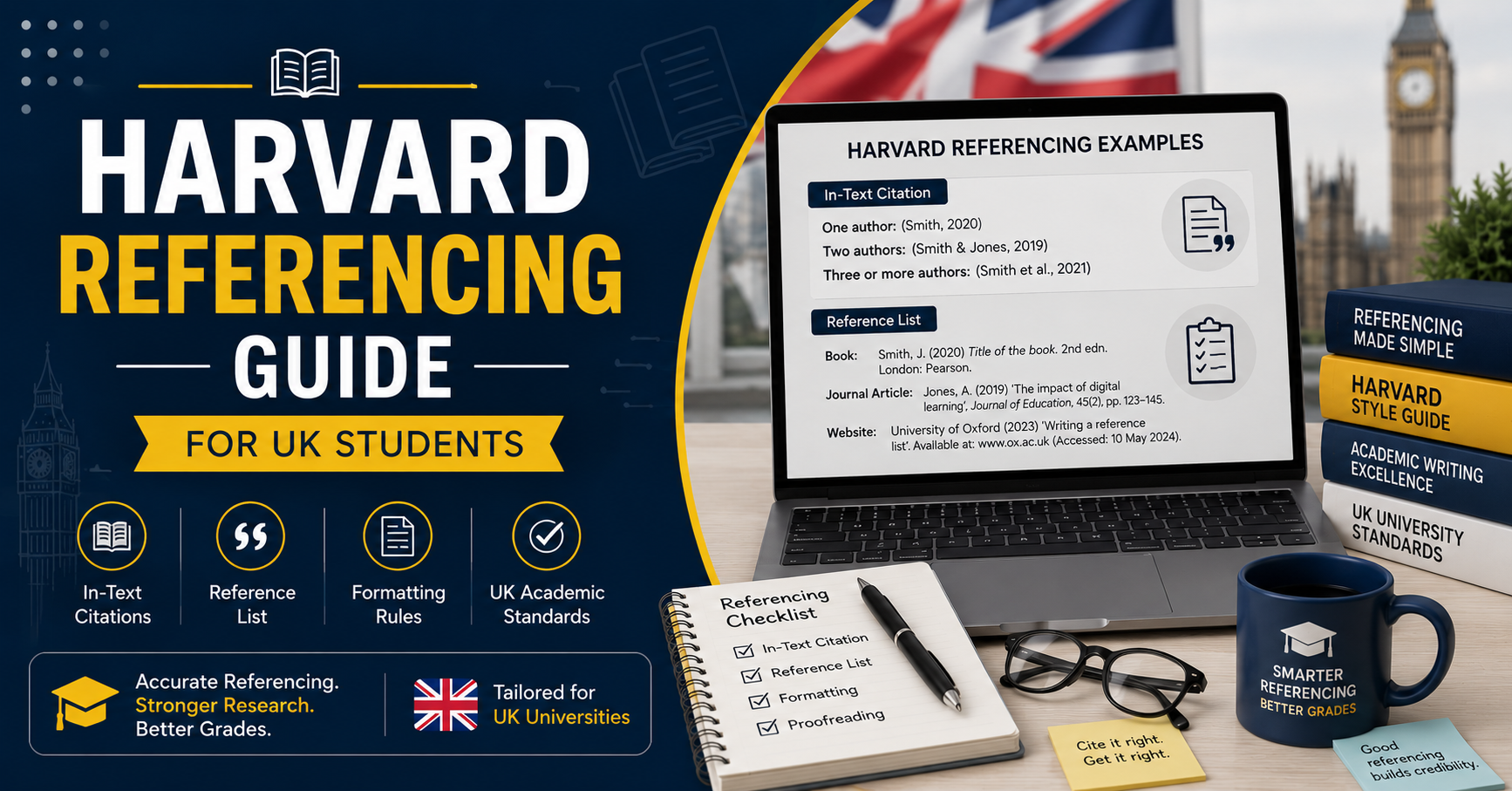
Harvard Referencing Guide for UK Students: A Practical Introduction
When you begin a dissertation, essay or research paper, the first question that often surfaces is how to acknowledge the sources that have shaped your argument. The Harvard Referencing Guide for UK Students offers a clear, consistent system that satisfies the expectations of most British universities while remaining flexible enough for a wide range of disciplines. This article walks you through the essential elements of Harvard style, from in‑text citations to the final reference list, and provides tips that will help you avoid common pitfalls. Whether you are an undergraduate tackling your first essay or a postgraduate polishing a thesis, the guidance here will save you time and protect you from accidental plagiarism.
Why Harvard Referencing Remains Popular in the UK
Harvard referencing, sometimes called the author‑date system, is favoured because it integrates smoothly with the flow of academic prose. By placing the author’s surname and the year of publication directly after the relevant idea, readers can instantly see the source of the information without having to flip to a footnote. This transparency aligns with the standards set by the Quality Assurance Agency for Higher Education (QAA) and supports the integrity of scholarly work.
Key advantages for students
First, Harvard style is widely accepted across subjects ranging from business studies to the humanities, which means you are unlikely to encounter a module that rejects it outright. Second, the format is straightforward to implement in word‑processing software; most reference managers such as EndNote or Zotero include built‑in Harvard templates. Third, because the citation includes the year, it encourages you to consider the timeliness of your sources, a factor that examiners often highlight in feedback.
Fundamentals of Harvard In‑Text Citations
In‑text citations are the brief pointers that appear within the body of your work. They consist of the author’s surname, the year of publication, and, when necessary, a page number. The basic structure looks like this: (Smith 2020) for a general reference, or (Smith 2020, p. 45) when you are quoting directly.
Single author
When a source has one author, simply include the surname and year. For example, a statement about student mobility might be cited as (Brown 2019).
Two authors
With two contributors, list both surnames separated by “and”. For instance, research on digital literacy could be referenced as (Taylor and Green 2021).
Three or more authors
If a work has three or more authors, cite the first surname followed by “et al.” and the year, such as (Williams et al. 2018). This keeps the text tidy while still crediting the original authors.
Corporate authors and no‑author works
Government reports or publications from organisations like the Office for Students are cited by the name of the body: (Office for Students 2022). When a source truly lacks an author, use the title in place of the name, for example (“Student Satisfaction Survey” 2020).
Constructing a Harvard Reference List
The reference list appears at the end of your document and provides full details for every source cited in the text. Entries are ordered alphabetically by the surname of the first author and formatted with a hanging indent. Below are the main categories you will encounter.
Books
Author(s) (year) Title of the Book. Edition (if not first). Place of publication: Publisher.
Example:
Johnson, L. (2017) Research Methods for Social Sciences. 2nd edn. London: Sage.
Edited volumes
Editor(s) (ed.) (year) Title of the Volume. Place of publication: Publisher.
Example:
Brown, A. and Smith, R. (eds.) (2019) Advances in Educational Policy. Oxford: Oxford University Press.
Journal articles
Author(s) (year) ‘Title of article’, Title of Journal, volume(issue), page range.
Example:
Lewis, P. (2020) ‘Student engagement in online learning’, Journal of Higher Education, 45(3), pp. 215‑230.
Chapters in edited books
Chapter author(s) (year) ‘Title of chapter’, in Editor(s) (ed.) Title of Book. Place of publication: Publisher, page range.
Example:
Martin, K. (2018) ‘Assessing digital competence’, in Clarke, J. (ed.) Digital Skills in the Modern Workplace. London: Routledge, pp. 78‑102.
Websites
Author or organisation (year) Title of web page. Available at: URL (Accessed: day month year).
Example:
Higher Education Statistics Agency (2023) Student enrolment data. Available at: https://www.hesa.ac.uk (Accessed: 10 April 2024).
Common Pitfalls and How to Avoid Them
Even seasoned students sometimes stumble over subtle details. Here are the most frequent errors and the steps you can take to correct them.
Inconsistent punctuation
Harvard style requires commas between author, year and page numbers, and periods after the final element of a reference. Double‑check each entry to ensure you have not mixed commas with semicolons or omitted necessary punctuation.
Incorrect author order
When a source lists multiple authors, the order in the reference list must match the order on the title page. Swapping surnames can mislead readers and may be flagged by plagiarism detection software.
Missing information
Always verify that you have captured the full title, edition, and publisher location. For online sources, the access date is essential because web content can change over time.
Using the wrong edition
If you consulted a later edition of a book, note it in the reference. Failing to do so can create confusion, especially when page numbers differ between editions.
Over‑reliance on a single source
While Harvard style does not limit the number of citations, a robust bibliography demonstrates breadth of research. Aim to include a mix of books, journal articles, reports and reputable websites.
Tools and Resources to Streamline Harvard Referencing
Manual formatting can be time‑consuming, but several tools can help you maintain accuracy.
Reference management software
Programs such as Zotero, Mendeley and EndNote allow you to import citation details directly from databases and automatically generate a Harvard reference list. They also enable you to switch between citation styles with a single click, which is handy if your department later adopts a different system.
University style guides
Most UK universities publish their own Harvard guidelines, often available on the library website. These guides clarify institution‑specific preferences, such as whether to italicise journal titles or how to handle multiple works by the same author in one year.
Online citation generators
Free tools like Cite This For Me or the Harvard Referencing Generator on the GOV.UK site can produce quick citations, but always verify the output against your university’s guide.
Applying Harvard Referencing Across Different Disciplines
The core principles of Harvard style remain the same, yet each discipline may have nuances. Understanding these helps you tailor your bibliography to the expectations of your field.
Humanities and Social Sciences
In literature or cultural studies, you may cite classic works that lack a publication year. In such cases, use the year of the edition you consulted, for example (Shakespeare 1992). When referencing archival material, include the collection name and accession number.
Sciences and Engineering
Scientific papers often require the inclusion of a DOI (digital object identifier). Place the DOI at the end of the reference after the page range: doi:10.1016/j.jhe.2020.03.004.
Business and Law
Legal documents follow a slightly different convention, but Harvard style can still be applied by treating statutes as corporate authors and adding the chapter or section number, for example (Companies Act 2006, s. 30).
Ensuring Academic Integrity with Harvard Referencing
Accurate citation is not merely a bureaucratic requirement; it is a cornerstone of academic honesty. By giving proper credit, you demonstrate respect for the intellectual labour of others and provide a trail that allows readers to verify your claims. This practice also protects you from accusations of plagiarism, which can have serious consequences ranging from loss of marks to disciplinary action.
If you find yourself uncertain about how to cite a particular source, consult your supervisor or the university’s writing centre. In some cases, seeking professional assistance can be beneficial. A reputable dissertation writing service can review your reference list for consistency, while a specialised essay writing service may offer guidance on integrating citations smoothly into your argument.
Step‑by‑Step Checklist for a Perfect Harvard Reference List
Before you submit your work, run through this checklist to confirm that every detail is in order:
- All in‑text citations have a corresponding entry in the reference list.
- Authors’ names are spelled correctly and appear in the same order as the source.
- Publication years are accurate and match the cited work.
- Titles are italicised where required and capitalisation follows the style guide.
- Page numbers are included for direct quotes and specific ideas.
- Online sources contain a full URL and the date you accessed the material.
- The reference list is alphabetised and uses a hanging indent.
- Consistent punctuation and spacing are applied throughout.
Conclusion: Mastering Harvard Referencing for Academic Success
Mastering the Harvard Referencing Guide for UK Students equips you with a reliable tool to present your research with clarity and credibility. By adhering to the conventions outlined above, you not only meet the expectations of your lecturers but also join a tradition of scholarly rigour that underpins the UK higher education system. Remember to plan your citations from the outset, use reference management software to stay organised, and double‑check each entry against your institution’s guide. With these practices in place, you can focus on developing strong arguments, confident that your sources are acknowledged correctly.
References
Brown, A. and Smith, R. (eds.) (2019) Advances in Educational Policy. Oxford: Oxford University Press.
Higher Education Statistics Agency (2023) Student enrolment data. Available at: https://www.hesa.ac.uk (Accessed: 10 April 2024).
Johnson, L. (2017) Research Methods for Social Sciences. 2nd edn. London: Sage.
Lewis, P. (2020) ‘Student engagement in online learning’, Journal of Higher Education, 45(3), pp. 215‑230.
Martin, K. (2018) ‘Assessing digital competence’, in Clarke, J. (ed.) Digital Skills in the Modern Workplace. London: Routledge, pp. 78‑102.
Taylor, J. and Green, S. (2021) ‘Digital literacy among undergraduates’, Education Review, 12(2), pp. 34‑50.
Williams, D., Patel, R. and O'Connor, L. (2018) ‘Innovations in teaching methods’, Teaching and Learning Journal, 22(1), pp. 101‑119.
Office for Students (2022) Higher education sector report. Available at: https://www.gov.uk (Accessed: 5 March 2024).

Comments (0)
Leave a Comment