
Introduction
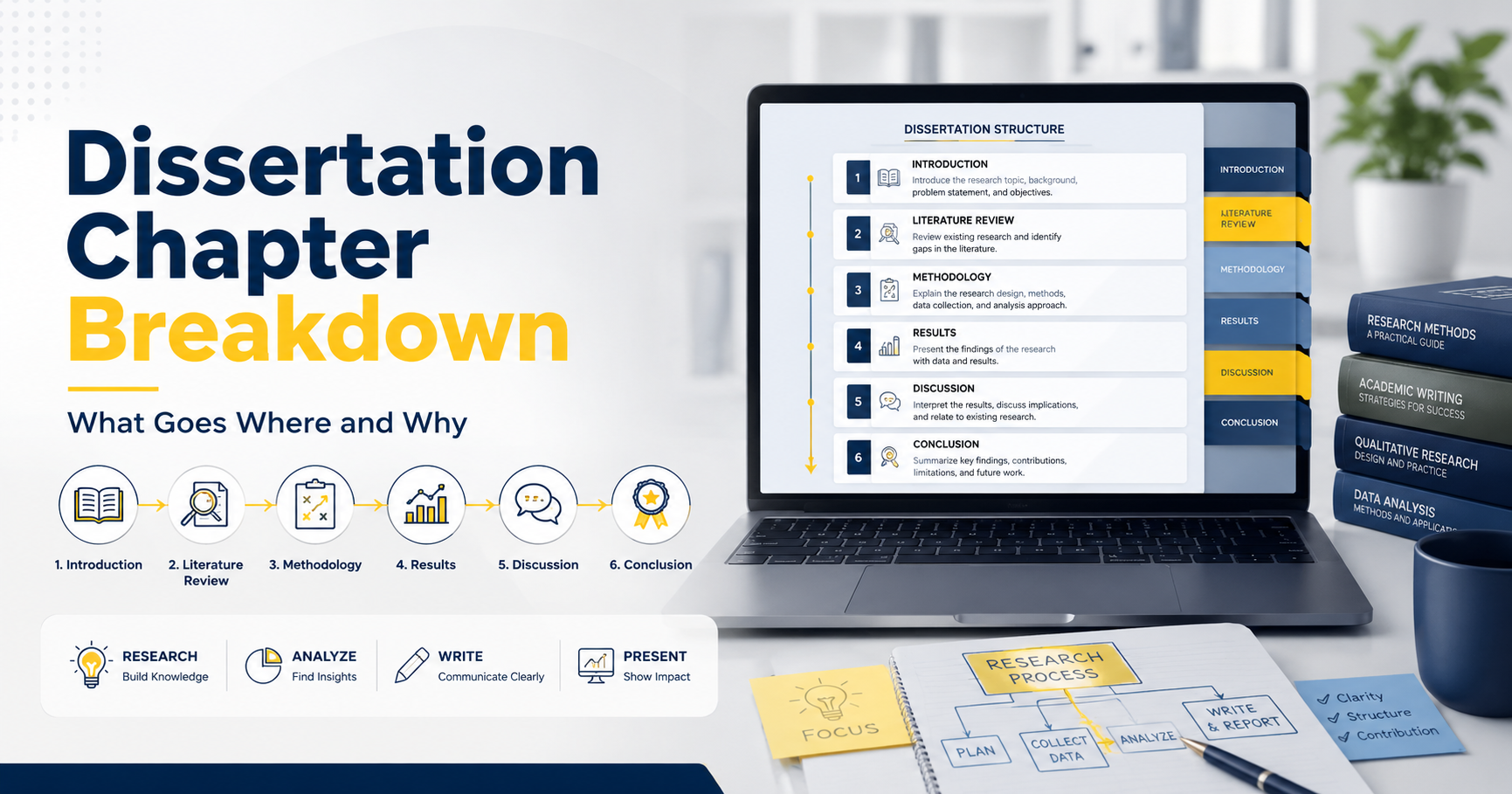
Writing a dissertation can feel like assembling a complex puzzle. Each piece must fit perfectly for the final picture to make sense. The most effective way to achieve this cohesion is to understand the dissertation chapter breakdown – what goes where and why. This guide walks you through every chapter, highlights the purpose of each section, and offers practical tips to keep your research on track. Whether you are tackling a PhD, a master’s thesis, or an undergraduate dissertation, a clear chapter structure is the backbone of academic success. If you need dissertation, essay or assignment help, professional writers can provide the support you need to stay on schedule.
1. The Front Matter: Setting the Scene
1.1 Title Page
The title page is the first impression of your work. It should display:
- Full dissertation title (concise yet descriptive)
- Your name and student number
- Degree programme and department
- University name and submission date
1.2 Abstract
The abstract is a 250‑300 word snapshot of your entire dissertation. It must summarise the research problem, methodology, key findings and conclusions. Write it last, but place it at the very beginning of the document.
1.3 Acknowledgements & Declaration
These sections are optional but customary. Acknowledge supervisors, peers and any funding bodies, and include a declaration of originality to satisfy university requirements.
1.4 Table of Contents, List of Figures & Tables
Automatic numbering in Word or LaTeX ensures accuracy. Keep these lists updated as you add or remove sections – a well‑structured table of contents is vital for both examiners and readers.
2. Chapter 1: Introduction
The introduction sets the context and outlines the research agenda. A strong opening chapter should contain:
- Background and rationale: Explain why the topic matters.
- Research problem: State the gap in existing literature.
- Aims and objectives: Clearly define what you intend to achieve.
- Research questions/hypotheses: Provide concise, answerable questions.
- Scope and limitations: Clarify the boundaries of your study.
- Structure of the dissertation: Briefly preview each subsequent chapter.
3. Chapter 2: Literature Review
The literature review demonstrates your scholarly awareness. It should:
- Critically analyse key theories, models and empirical studies.
- Identify contradictions, gaps and trends in the field.
- Justify the theoretical framework that underpins your research.
- Lead logically to your research questions, establishing a clear link between existing knowledge and your study.
Remember to synthesise rather than merely summarise – show how each source contributes to your argument.
4. Chapter 3: Methodology
This chapter explains *how* you will answer your research questions. Include:
- Research design: Qualitative, quantitative or mixed‑methods.
- Data collection methods: Surveys, interviews, experiments, archival research, etc.
- Sampling strategy: Population, sample size and justification.
- Data analysis techniques: Statistical tests, thematic coding, discourse analysis, etc.
- Ethical considerations: Consent, confidentiality, and any institutional approvals.
- Reliability and validity (or trustworthiness): How you will ensure rigour.
A transparent methodology enables reproducibility and convinces examiners of the credibility of your findings.
5. Chapter 4: Results / Findings
Present the data without interpretation. Use tables, figures and descriptive text to make patterns evident. Tips for a clear results chapter:
- Follow the order of your research questions.
- Label every table/figure and provide concise captions.
- Report statistical significance, effect sizes, and confidence intervals where relevant.
- Avoid discussing implications – save that for the next chapter.
6. Chapter 5: Discussion
The discussion is where you interpret your findings. Connect your results back to the literature review and theoretical framework. Address:
- How your findings answer each research question.
- Whether they support or challenge existing theories.
- Possible explanations for unexpected results.
- Implications for practice, policy or further research.
Critical reflection demonstrates depth of understanding – a key criterion in UK dissertations.
7. Chapter 6: Conclusion and Recommendations
Summarise the main contributions of your work in a concise paragraph. Then provide:
- Practical recommendations based on your findings.
- Suggestions for future research, highlighting remaining gaps.
- A final reflection on the research process and any methodological limitations.
8. The Back Matter: Appendices and References
Appendices contain supplementary material such as questionnaires, interview transcripts, or detailed statistical output. Ensure each appendix is referred to in the main text.
References must follow the citation style mandated by your department (Harvard, APA, Vancouver, etc.). Consistency is essential; reference management software can save hours and reduce errors.
Conclusion
A well‑planned dissertation chapter breakdown not only guides your writing but also signals to examiners that you have a logical, coherent approach to research. By allocating the right content to each chapter, you create a narrative that is easy to follow and academically robust. If you find yourself struggling with any part of this structure, professional dissertation, essay or assignment help can provide the expertise you need to stay on track and achieve a high‑quality submission.
Ready to streamline your dissertation? Contact Top Dissertation Writers today for personalised support and ensure every chapter lands exactly where it belongs.


Comments (0)
Leave a Comment