
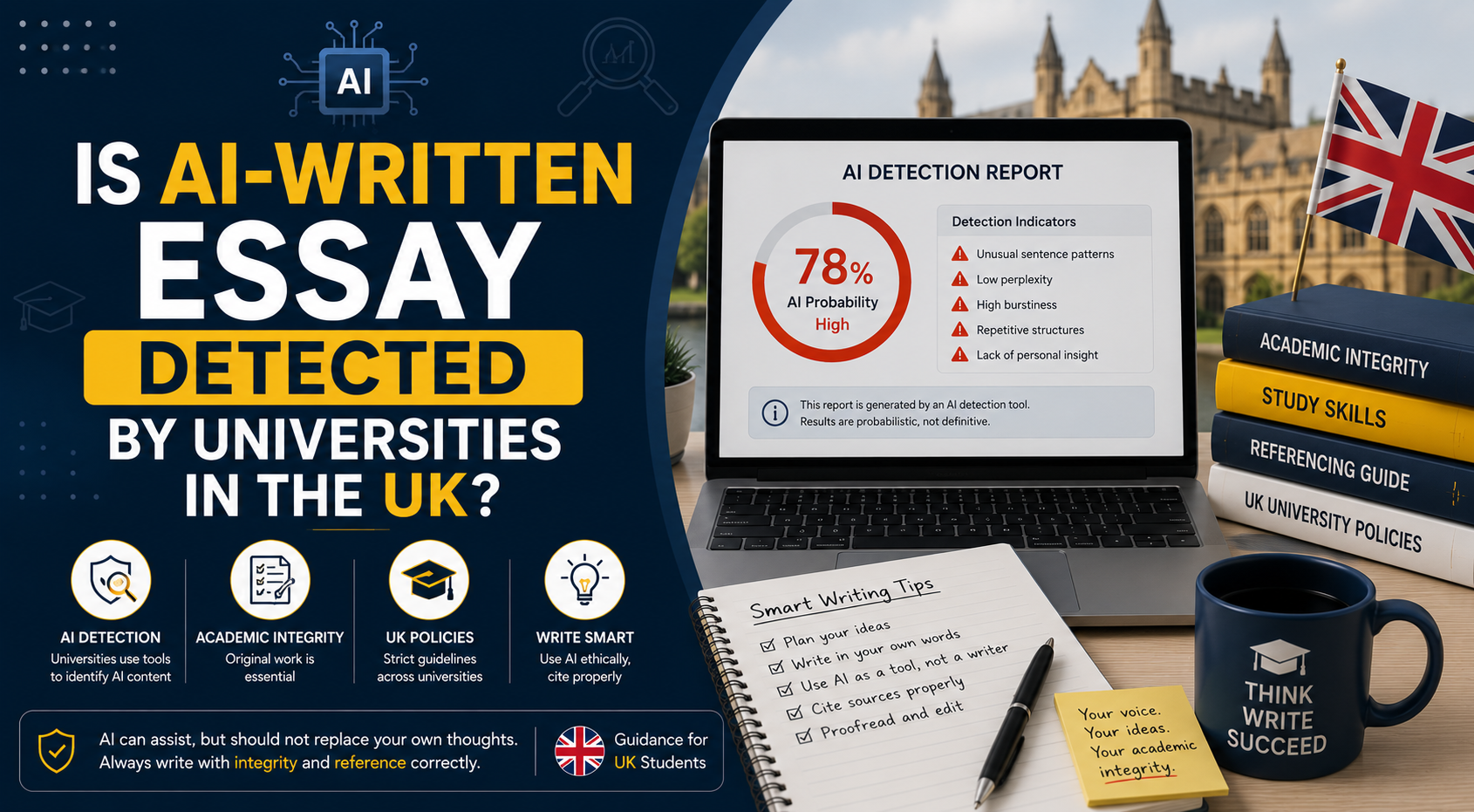
Is AI‑Written Essay Detected by Universities in the UK?
When a student asks whether an AI‑generated essay can be spotted by a UK university, the answer is never a simple yes or no. The reality sits somewhere between sophisticated detection software, human judgement and the changing expectations of academic integrity. In this article I will unpack how universities identify AI‑written work, what tools are currently in use, the limitations of those tools, and what students can do to stay on the right side of the law while still benefiting from technology.
Why the Question Matters
Artificial intelligence has moved from a niche curiosity to a mainstream tool in a few short years. Large language models such as ChatGPT, Claude and Gemini can produce essays that read fluently, cite sources and even mimic a particular academic style. For a busy student, the temptation to let the algorithm do the heavy lifting is obvious. Yet universities in the United Kingdom have tightened their policies on plagiarism and contract cheating, and many have explicitly mentioned AI‑generated content in their codes of conduct. Understanding how detection works is therefore essential not just for avoiding sanctions but for preserving the integrity of one’s own learning.
How Universities Detect AI‑Written Work
1. Turnitin and the Rise of AI‑Detection Modules
Turnitin, the most widely used similarity‑checking service in UK higher education, introduced an AI‑detection add‑on in 2023. The module analyses text for patterns that are statistically unlikely to be produced by a human writer. These include unusually consistent sentence length, a lack of personal anecdotes and certain lexical choices that AI models tend to repeat. When a submission triggers a high AI‑score, the system flags it for further review by the lecturer or the module leader.
2. Originality.ai and Other Dedicated Tools
Originality.ai, Copyleaks and GPTZero are examples of third‑party platforms that specialise in AI detection. They work by comparing the submitted text against a massive database of AI‑generated outputs and by applying machine‑learning classifiers trained on both human and AI writing samples. Some universities have integrated these tools directly into their virtual learning environments, allowing automatic checks before a student can submit the final version.
3. Human Expertise and Stylometric Analysis
Even the most advanced algorithms cannot replace the intuition of an experienced academic. Lecturers often look for mismatches between a student’s known writing style and the submitted essay. Stylometric analysis – the statistical study of writing style – can highlight anomalies in word choice, punctuation, and sentence complexity. If a dissertation suddenly displays a level of sophistication far beyond previous work, the examiner may request a draft history or an oral defence.
What the Detection Tools Look For
AI‑detection software does not search for a hidden watermark; instead it evaluates a combination of linguistic cues. Below are the most common signals:
- Repetition of high‑frequency phrases – language models often reuse certain connective words and filler expressions.
- Uniform sentence length – human writing tends to vary more naturally.
- Lack of personal experience – essays that avoid first‑person anecdotes or specific examples may raise suspicion.
- Bibliography anomalies – AI can fabricate references that look plausible but are not verifiable.
- Statistical improbabilities – the probability of certain word combinations occurring together is extremely low in genuine human text.
The Accuracy Debate: False Positives and Negatives
No detection system is infallible. Studies from the University of Cambridge and the University of Edinburgh have shown that false‑positive rates can reach 10 % for sophisticated AI outputs, especially when students edit the raw AI text heavily. Conversely, a well‑crafted prompt and post‑editing can produce an essay that evades detection altogether, leading to false negatives. This uncertainty means that universities are increasingly adopting a layered approach: software flagging, followed by human verification.
University Policies Across the United Kingdom
Each institution has its own set of guidelines, but common themes emerge. The following snapshot illustrates the current landscape:
- University of Oxford – The Academic Integrity Policy explicitly bans the unauthorised use of AI tools for assessment tasks.
- University of Manchester – Requires students to declare any AI assistance in a dedicated section of the assignment cover sheet.
- University of Glasgow – Uses Turnitin’s AI‑detection module for all undergraduate essays and reserves the right to conduct additional checks.
- London School of Economics – Offers a “Responsible Use of AI” workshop and expects students to cite AI contributions where applicable.
These policies are reinforced by national guidance from the Office for Students and the Quality Assurance Agency (QAA), which have both issued statements urging higher education providers to treat AI‑generated work as a form of contract cheating unless properly acknowledged.
Best Practices for Students
1. Treat AI as a Research Assistant, Not a Writer
If you use a language model to brainstorm ideas, generate outlines or suggest sources, keep a clear record of the interaction. Write the final essay yourself, incorporating your own analysis and voice. This approach not only reduces the risk of detection but also ensures that you truly understand the material – a crucial factor for later exams.
2. Cite Any AI Contributions
Some universities are beginning to accept AI assistance provided it is transparently cited. For example, you might add a footnote: “Text generated with the assistance of ChatGPT, OpenAI, 2024.” Checking the specific citation style guide for your programme is essential, as requirements can differ between Harvard, Vancouver and APA formats.
3. Use Plagiarism‑Check Tools Before Submitting
Running your own draft through Turnitin or a free AI‑detector can give you a sense of whether the text looks too uniform. If the AI‑score is high, edit the essay to introduce personal reflections, varied sentence structures and genuine examples.
4. Develop a Personal Writing Style
Consistent practice in academic writing builds a signature style that is hard for AI to replicate. Maintaining a portfolio of past essays, lab reports and reflective journals can serve as evidence of your authentic voice if an accusation ever arises.
5. Seek Professional Guidance When Stuck
When you reach an impasse, consider asking a tutor, joining a study group or, if appropriate, using a reputable essay writing service for guidance. A professional service can help you understand the structure of an essay without producing the final text for you, keeping you within the bounds of academic integrity.
Future Trends: Will Detection Keep Up?
AI technology evolves faster than any policy framework. Researchers are already experimenting with “watermarking” AI output, embedding invisible signals that can be detected by specialised software. Meanwhile, universities are investing in continuous training for staff, ensuring that examiners stay aware of the latest AI capabilities.
One likely scenario is a hybrid model where AI‑detection tools become a routine part of the submission workflow, much like similarity checks are today. At the same time, institutions may adopt clearer guidelines that differentiate between permissible AI assistance (e.g., language editing) and prohibited content generation.
Conclusion: Navigating the Grey Area with Confidence
In short, AI‑written essays can be detected by UK universities, but the process is not black and white. Detection tools flag statistical anomalies, while human reviewers interpret those flags in the context of a student’s known abilities. The safest path is to use AI as a supportive tool – for brainstorming, outlining and language polishing – while ensuring that the core analysis, argumentation and voice remain unequivocally yours.
By staying informed about university policies, employing transparent citation practices and developing a personal writing style, you can benefit from the efficiency of AI without jeopardising your academic record. Should you ever feel uncertain, remember that professional guidance, such as a reputable dissertation writing service, can provide the clarity you need while respecting the boundaries of academic honesty.
References
British Council (2023) Academic Integrity in the UK Higher Education Sector. London: British Council.
College of Policing (2024) Guidance on the Use of Artificial Intelligence in Professional Settings. London: College of Policing.
Quality Assurance Agency (2023) Managing the Use of AI in Higher Education. London: QAA.
Turnitin (2024) AI Detection Overview. London: Turnitin Ltd.
University of Oxford (2023) Academic Integrity Policy. Oxford: University of Oxford.
University of Manchester (2023) Student Academic Conduct Handbook. Manchester: University of Manchester.
Comments (0)
Leave a Comment